

Brunette hair offers the perfect canvas for stunning balayage transformations that can enhance your natural beauty and add incredible dimension to your locks.
The art of balayage has revolutionized hair coloring by creating seamless, natural-looking highlights that complement brunette tones beautifully.
Understanding balayage for brunettes and how to do it right opens up a world of possibilities for customizing your look, whether you prefer subtle sun-kissed effects or bold, dramatic contrasts.
This comprehensive guide will equip you with expert knowledge, professional techniques, and insider secrets to achieve flawless balayage results that enhance your brunette base while maintaining hair health and integrity.
This article explores the fundamentals of brunette balayage, from understanding your base color to mastering application techniques, selecting perfect highlight shades, managing processing times, and maintaining your beautiful results.
You’ll discover professional-grade methods, troubleshooting strategies, and long-term care approaches that ensure your balayage looks stunning for months.
1. Understanding Brunette Hair and Balayage Compatibility

Brunette hair provides an ideal foundation for balayage techniques due to its rich pigmentation and versatile color depth.
Understanding how different brunette shades interact with highlighting methods is crucial for achieving optimal results and maintaining hair health throughout the coloring process.
- Brunette hair contains complex melanin structures that respond predictably to lightening processes
- Natural brunette bases range from level 2 (darkest brown) to level 6 (light brown) on the color scale
- Each brunette level requires different lightening approaches and processing times for optimal results
- Dark brunettes (levels 2-3) showcase dramatic contrast with properly placed highlights
- Medium brunettes (levels 4-5) offer versatility for both subtle and bold balayage effects
- Light brunettes (levels 5-6) blend seamlessly with blonde highlights for natural sun-kissed looks
- Virgin brunette hair lifts more evenly than previously colored or chemically treated hair
- Understanding your natural undertones helps predict how highlights will develop during processing
- Warm brunette bases complement golden and caramel highlight tones beautifully
- Cool brunette bases work well with ash and beige highlight shades
- Neutral brunette bases offer flexibility to work with various highlight color families
- The porosity of brunette hair affects highlight placement and color development timing
2. Essential Color Theory for Brunette Balayage

Mastering color theory is fundamental to creating beautiful brunette balayage that looks natural and professionally executed.
Understanding how colors interact, complement, and contrast with brunette bases ensures harmonious results that enhance your overall appearance.
- The color wheel guides highlight selection based on complementary and analogous relationships
- Warm highlight tones include gold, honey, caramel, copper, and rich amber shades
- Cool highlight tones encompass ash, beige, mushroom blonde, and pearl variations
- Neutral highlights bridge warm and cool tones for versatile, wearable results
- Contrast levels determine how dramatic or subtle your balayage transformation appears
- High contrast balayage uses highlights 3-4 levels lighter than your natural base
- Medium contrast balayage employs highlights 2-3 levels lighter for natural-looking results
- Low contrast balayage features highlights 1-2 levels lighter for subtle enhancement
- Understanding undertones prevents unwanted color results like orange or brassy highlights
- Red undertones in brunette hair may require special consideration during the lightening process
- Color placement theory guides where highlights should be positioned for maximum impact
- Face-framing highlights should complement your skin tone and facial features
3. Pre-Service Consultation and Hair Assessment
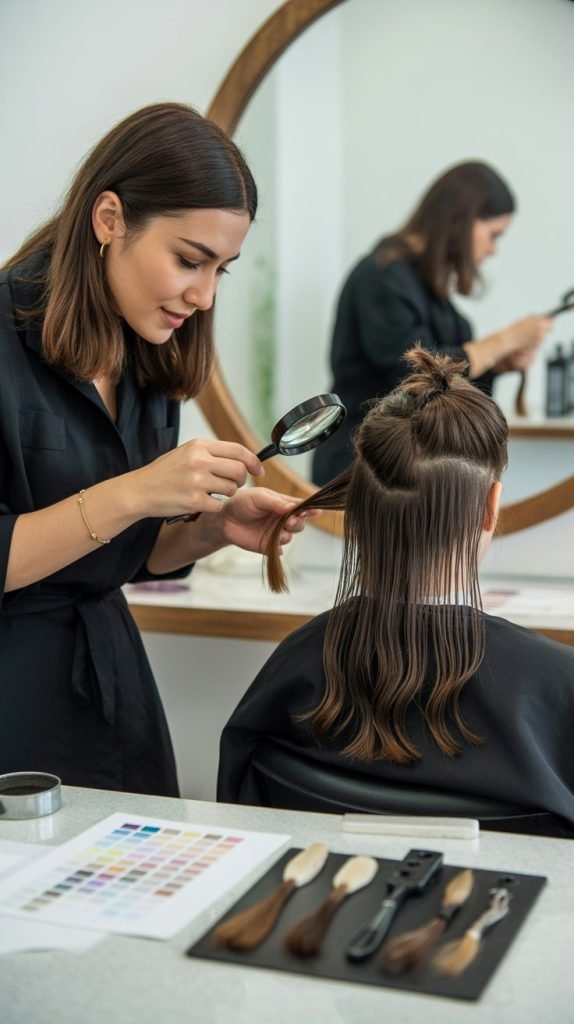
Thorough consultation and hair assessment form the foundation of successful brunette balayage services.
This critical step identifies potential challenges, sets realistic expectations, and creates a customized plan for achieving your desired results safely and effectively.
- Document your hair’s natural color level using professional color reference charts
- Assess hair porosity through water absorption tests to predict color uptake
- Evaluate hair elasticity by gently stretching damp strands to test structural integrity
- Record any previous chemical treatments including relaxers, perms, or color services
- Examine scalp condition for sensitivity issues or contraindications to chemical processing
- Take detailed photos of current hair color and texture for reference purposes
- Discuss realistic timeline expectations for achieving desired balayage results
- Identify any lifestyle factors that might affect maintenance requirements
- Perform mandatory strand tests to preview color development and processing times
- Review aftercare commitments and maintenance scheduling requirements
- Establish clear communication about desired outcome versus achievable results
- Create detailed service notes for consistent future appointments and touch-ups
4. Professional Tools and Product Selection

Choosing the right professional tools and products is essential for executing flawless brunette balayage techniques. Quality equipment and formulations ensure consistent results while minimizing damage and maximizing color longevity.
- Professional balayage brushes with natural bristles provide smooth, even color application
- Paddle brushes work best for broad highlight sections and seamless blending
- Detail brushes allow for precise color placement in face-framing areas
- Non-metallic mixing bowls prevent chemical reactions with lightening products
- Wide-tooth combs facilitate gentle sectioning without causing hair damage
- Professional sectioning clips organize hair efficiently during application processes
- High-quality foils or balayage boards isolate sections during color processing
- Premium lightening products offer better lift with less damage than drugstore alternatives
- Developer selection impacts both processing speed and final color results
- Toner varieties provide options for customizing final highlight tones
- Deep conditioning treatments support hair health throughout the coloring process
- Color-safe aftercare products maintain balayage results between service appointments
5. Sectioning Patterns and Placement Strategies

Strategic sectioning and highlight placement are crucial elements that distinguish professional balayage from amateur attempts.
Understanding how to map hair sections and position highlights creates natural-looking dimension that enhances your brunette base beautifully.
- Traditional balayage sectioning creates natural randomness through strategic planning
- Horizontal sections provide foundation structure for systematic color application
- Vertical subsections within horizontal parts allow for varied highlight thickness
- Triangle sections around the face create concentrated brightness for facial framing
- Diagonal sectioning patterns mimic natural hair growth and movement patterns
- Brick-lay sectioning prevents obvious lines and creates seamless color blending
- Hair density affects sectioning size and highlight placement frequency
- Fine hair requires smaller sections with closer highlight placement for visible impact
- Thick hair benefits from larger sections with strategic highlight concentration
- Face shape considerations influence where highlights should be most concentrated
- Natural part lines guide placement decisions for the most flattering results
- Varying section sizes creates organic, natural-looking highlight distribution
6. Step-by-Step Application Technique Mastery

Executing perfect balayage application requires mastering specific brush techniques, color placement methods, and timing strategies.
This systematic approach ensures consistent, professional results that enhance brunette hair beautifully.
- Begin application with hair in natural fall to assess optimal highlight placement
- Load balayage brush with appropriate amount of lightener to prevent dripping
- Start color application 2-3 inches away from roots for natural gradation effects
- Use feathering brush strokes to blend color seamlessly into natural hair
- Apply heavier color saturation toward hair ends where maximum lift is desired
- Vary pressure and brush angle to create natural-looking color variation
- Work systematically through mapped sections to maintain consistent timing
- Focus additional color around face-framing areas for maximum brightening impact
- Use upward brush strokes to lift and separate hair during application
- Maintain consistent working speed to ensure even processing across all sections
- Place protective barriers under sections to prevent unwanted color transfer
- Monitor first sections applied to gauge appropriate processing progression
7. Processing Time Management and Development Monitoring

Proper timing and careful monitoring of color development are critical for achieving optimal brunette balayage results while maintaining hair integrity.
Understanding visual cues and processing stages helps you make informed decisions throughout the lightening process.
- Initial color development begins within 10-15 minutes of lightener application
- Processing times vary from 25-50 minutes depending on desired lift level
- Fine hair textures typically process faster than coarse or thick hair types
- Virgin brunette hair generally lifts more quickly than previously processed hair
- Color development follows predictable stages from brown to orange to yellow
- Monitor processing every 10 minutes after the initial 20-minute mark
- Stop processing when hair reaches one level lighter than target result
- Toner application will further adjust and refine the final highlight color
- Over-processing leads to hair damage and potential breakage issues
- Under-processing results in brassy, incomplete color transformation
- Environmental factors like heat and humidity can affect processing speeds
- Document timing for individual clients to improve future service consistency
8. Toning Techniques for Perfect Brunette Balance

Toning is the crucial finishing step that transforms lifted brunette hair into beautifully balanced highlights that complement your natural base.
Mastering toning techniques ensures your balayage looks polished and professionally executed.
- Toners neutralize unwanted undertones revealed during the lightening process
- Yellow undertones require violet or purple-based toners for neutralization
- Orange undertones need blue-based toners to achieve proper color balance
- Toner selection depends on desired final result and underlying pigment exposure
- Apply toner to towel-dried hair for optimal product penetration and development
- Processing times range from 5-20 minutes based on hair porosity and desired intensity
- Semi-permanent toners provide gentle color adjustment with minimal commitment
- Demi-permanent toners offer longer-lasting results with enhanced durability
- Gloss treatments add shine while subtly adjusting highlight tones
- Multiple toning sessions may be necessary for severely compromised color
- Monitor toning development carefully to prevent over-processing and muddy results
- Document successful toner formulas for consistent maintenance appointments
9. Brunette Balayage Maintenance and Longevity

Maintaining beautiful brunette balayage requires understanding proper care techniques, scheduling regular touch-ups, and using appropriate products to preserve color integrity and hair health between salon visits.
- Schedule balayage touch-ups every 12-16 weeks for optimal color maintenance
- Root touch-ups focus on new growth areas while preserving existing highlights
- Toning refresh appointments every 6-8 weeks maintain desired highlight tones
- Use sulfate-free shampoos to prevent premature color fading and dryness
- Deep conditioning treatments weekly help maintain hair health and shine
- Purple or blue shampoos counteract brassiness between professional toning sessions
- Heat protection products prevent color fading from thermal styling tools
- UV protection sprays shield hair color from sun damage and environmental factors
- Document maintenance schedules and product preferences for consistent results
- Adjust maintenance frequency based on hair growth rate and lifestyle factors
- Monitor hair condition between appointments and modify care routines accordingly
- Consider seasonal color adjustments to complement changing style preferences
10. Troubleshooting Common Brunette Balayage Issues

Even experienced colorists encounter challenges when creating brunette balayage. Understanding how to identify and correct common problems ensures you can achieve beautiful results while maintaining hair health and client satisfaction.
- Uneven color development often results from inconsistent application or sectioning
- Brassy highlights indicate insufficient toning or inappropriate toner selection
- Harsh demarcation lines can be softened through root smudging techniques
- Over-processed hair requires immediate deep conditioning and protein treatments
- Color that appears too light can be adjusted with semi-permanent color deposits
- Patchy results typically stem from overlapping applications or timing issues
- Orange-toned highlights need blue-based color correction for proper neutralization
- Muddy or ashy results usually occur from over-toning or wrong toner selection
- Scalp irritation requires immediate product removal and professional assessment
- Hair breakage indicates the need for restructuring treatments and processing modifications
- Document all correction procedures and successful solutions for future reference
- Seek additional professional training when encountering complex correction scenarios
11. Advanced Brunette Balayage Techniques and Trends

Staying current with advanced balayage techniques and emerging trends ensures your brunette color services remain fresh, modern, and highly sought after.
These innovative approaches expand your creative possibilities and client satisfaction.
- Shadow root techniques create seamless transitions between natural roots and highlights
- Color melting blends multiple highlight tones for dimensional, multi-faceted results
- Ribbon highlighting creates bold, strategic color placement for dramatic impact
- Face-framing balayage concentrates brightness around facial features for enhanced contouring
- Reverse balayage adds darker tones to over-highlighted hair for natural-looking depth
- Babylight techniques create subtle, fine highlights that mimic childhood hair color
- Tortoiseshell balayage combines warm and cool tones for rich, luxurious dimension
- Lived-in color approaches emphasize natural-looking, low-maintenance results
- Seasonal color adjustments keep balayage fresh and contemporary throughout the year
- Customization techniques adapt balayage to individual facial features and lifestyle needs
- Creative color placement can camouflage hair growth patterns and cowlicks
- Integration with cutting techniques enhances overall hair design and movement
Mastering balayage for brunettes and how to do it right requires dedication to proper technique, understanding of color theory, and commitment to ongoing education.
This comprehensive guide has provided you with the knowledge, tools, and strategies necessary to create stunning brunette balayage results that enhance natural beauty while maintaining hair health.
Remember that practice, patience, and attention to detail are essential for developing your balayage skills.
Whether you’re a professional colorist or someone interested in understanding the process, these techniques will help you achieve the gorgeous, dimensional brunette hair that balayage is famous for creating.
