
Top 33 Best Cornrow Hairstyles for Kids with Natural Hair
Finding the perfect hairstyle for your child’s natural hair can feel overwhelming, but cornrows offer a beautiful solution that combines style, protection, and practicality.
In this comprehensive guide to the Top 33 Best Cornrow Hairstyles for Kids with Natural Hair, you’ll discover a diverse collection of protective styles that celebrate your child’s natural texture while keeping their hair healthy and manageable.
From simple straight-back designs perfect for school days to intricate patterns ideal for special occasions, these cornrow styles cater to every personality, hair length, and skill level.
Whether you’re a parent looking to master basic braiding techniques or seeking inspiration for your next salon visit, this article provides detailed insights into trending designs, maintenance tips, and age-appropriate options that will keep your little one looking stylish and feeling confident.
Get ready to explore creative patterns, learn about hair care essentials, and find the perfect cornrow style that your child will love wearing for weeks to come.
1. Classic Straight-Back Cornrows
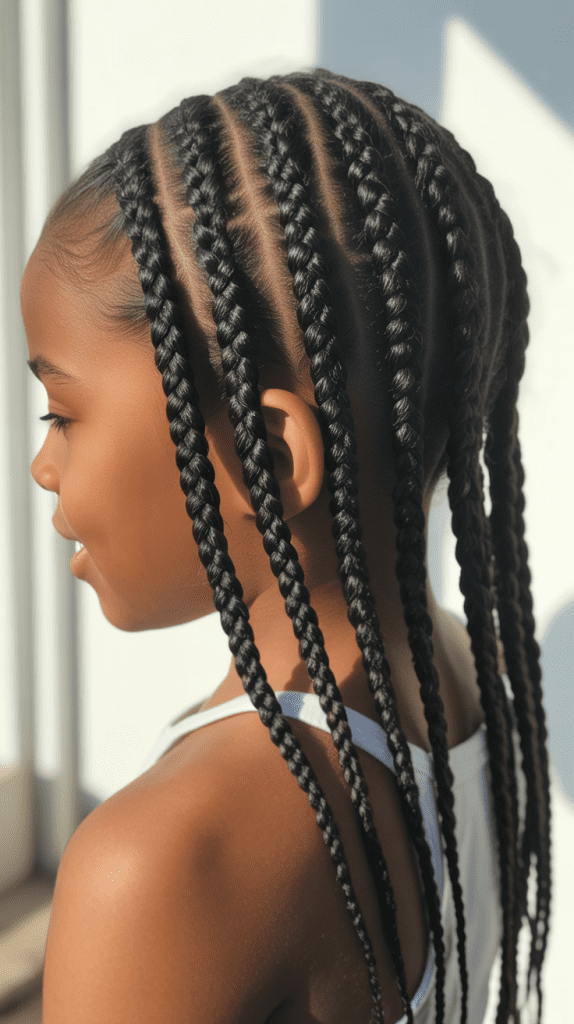
The classic straight-back cornrow style remains timeless and practical for children of all ages.
This fundamental design features neat, parallel rows that run from the front hairline to the nape of the neck, creating a clean and polished appearance.
It’s an excellent choice for active kids who need their hair securely styled for school, sports, or play.
Key Features:
- The straight-back pattern typically consists of 4 to 8 rows depending on hair thickness and desired size
- This style works exceptionally well for medium to long natural hair lengths
- The uniform direction helps distribute tension evenly across the scalp, minimizing discomfort
- Parents appreciate this style because it requires minimal morning maintenance and lasts 2-3 weeks with proper care
- The simplicity of the design makes it perfect for beginners learning to cornrow
Styling Considerations:
- Use a rat-tail comb to create precise, even parts between each row
- Apply edge control or styling gel along the hairline for a sleek, finished look
- Consider the child’s scalp sensitivity when determining how tightly to braid
- Add colorful beads or hair cuffs at the ends for a playful, personalized touch
- This versatile foundation can be dressed up or down depending on the occasion
2. Zigzag Pattern Cornrows
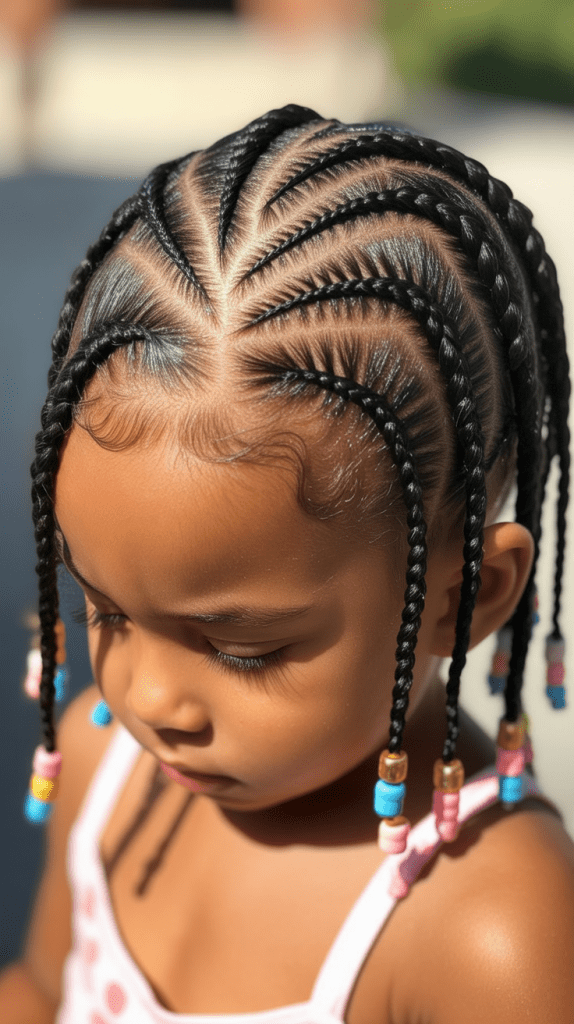
Zigzag pattern cornrows introduce geometric creativity to traditional braiding techniques.
This eye-catching style features rows that alternate directions in sharp angular patterns, creating visual interest and dimension across the scalp.
Children who want to stand out will love this playful yet protective option.
Design Elements:
- The zigzag effect is created by changing the direction of each cornrow at regular intervals
- This pattern works best on hair that’s at least 3-4 inches in length for proper grip
- The alternating angles help camouflage natural parts and growth patterns
- Skilled braiders can incorporate multiple zigzag sizes for added complexity
- The style typically requires 1.5 to 2.5 hours to complete depending on intricacy
Maintenance Tips:
- Sleep with a satin or silk bonnet to preserve the pattern definition
- Apply light oil to the scalp every 2-3 days to prevent dryness
- Avoid heavy products that can cause buildup between the zigzag paths
- Gently cleanse the scalp with diluted shampoo using an applicator bottle
- The style generally lasts 2-4 weeks before requiring a refresh
3. Heart-Shaped Cornrow Design
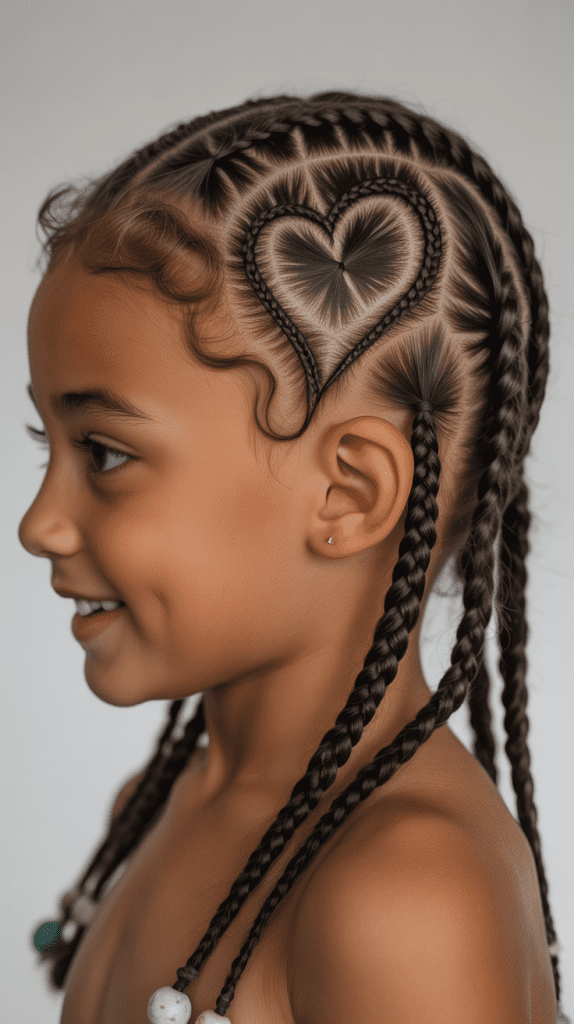
Heart-shaped cornrow designs capture childhood innocence and sweetness through adorable patterning.
This romantic style features cornrows carefully arranged to form one or multiple heart shapes across the scalp, making it perfect for Valentine’s Day, birthdays, or any day your child wants to feel extra special.
The design showcases advanced braiding skills while delivering undeniable charm.
Creative Approach:
- The heart outline is formed by curving two cornrows that meet at a center point
- Braiders typically position the heart at the crown or side of the head for maximum visibility
- Surrounding cornrows are styled to complement and frame the heart shape
- The design requires precision parting and careful tension control to maintain the curved lines
- Children can choose between a single large heart or multiple smaller hearts scattered throughout
Special Occasion Styling:
- Add red or pink beads at strategic points to enhance the romantic theme
- Incorporate ribbon or yarn in coordinating colors woven through the braids
- This style photographs beautifully for school pictures and family portraits
- The heart pattern typically remains visible for 1-2 weeks before natural hair growth softens the definition
- Parents often request this design for special events, holidays, and celebrations
4. Cornrows with Beads
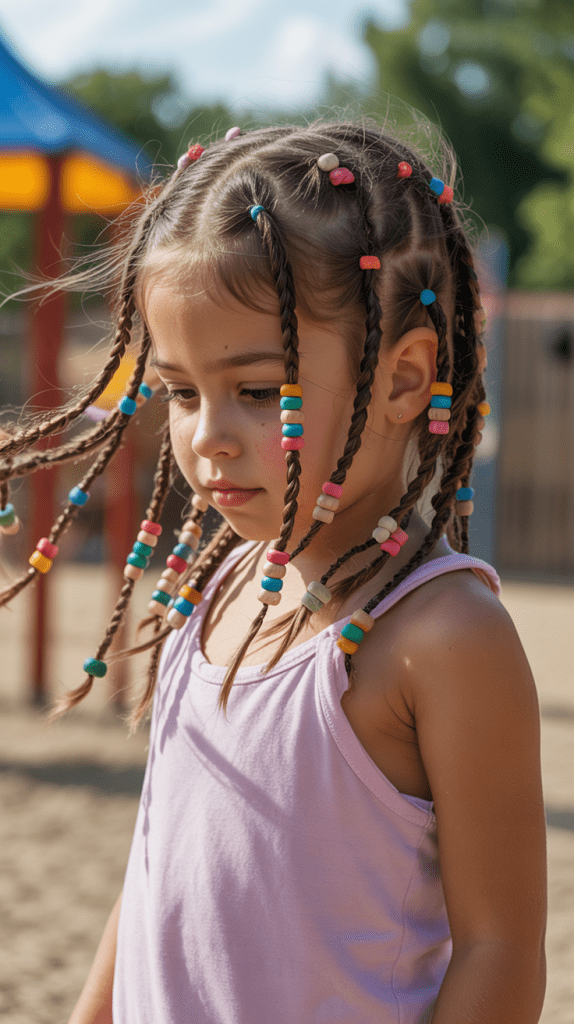
Cornrows with beads transform a simple protective style into a vibrant expression of personality and culture.
This beloved combination allows children to add color, sound, and movement to their hairstyle through carefully selected beads threaded onto the ends or throughout the length of their braids.
The clicking sound of beads has been a cherished part of Black hair culture for generations.
Bead Selection Guide:
- Wooden beads are lightweight and comfortable for all-day wear
- Plastic beads offer the widest variety of colors and shapes at affordable prices
- Metal cuffs and charms provide a modern, edgy aesthetic for older children
- Cowrie shells connect to African heritage and traditional adornment practices
- Ensure all beads have smooth edges to prevent hair breakage or scalp irritation
Application Methods:
- Thread beads onto braids using a small elastic band or threading tool
- Secure beads at the ends with small rubber bands that match the hair color
- Create patterns by alternating bead colors across different cornrows
- Some parents prefer leaving a few rows bead-free for variety and visual balance
- Remove beads gently by cutting the securing band rather than pulling
Practical Benefits:
- Beads add weight that can help straighten naturally curly ends
- The decorative elements make hair care routines more enjoyable for reluctant children
- Clicking sounds provide sensory feedback that many kids find satisfying
- Beads protect the ends of braids from unraveling prematurely
- The style allows for easy customization to match outfits or school colors
5. Side-Swept Cornrows
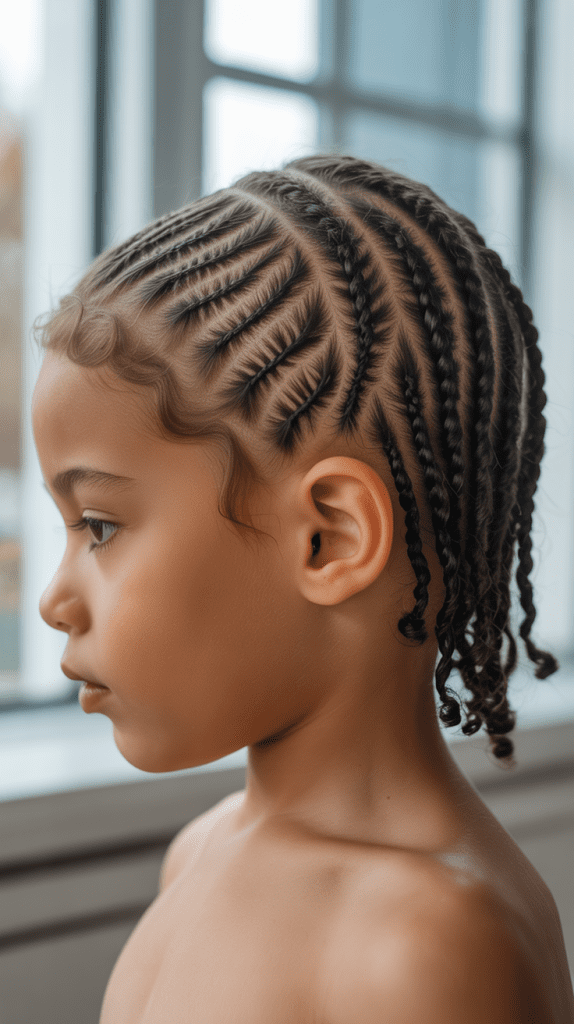
Side-swept cornrows offer an elegant asymmetrical look that adds sophistication to children’s protective styling.
This design features all cornrows flowing diagonally from one side of the head to the other, creating a graceful sweep that frames the face beautifully.
It’s particularly flattering for children with heart-shaped or oval face structures.
Styling Mechanics:
- The starting point is typically above one ear, with braids angling toward the opposite side
- Rows can vary in size from micro-fine to chunky depending on desired drama
- The diagonal angle creates an optical illusion that can make the face appear longer
- This style naturally showcases one side of the face while keeping hair away from the eyes
- The swept direction allows for creative styling of the loose ends into buns, ponytails, or left hanging
Versatility Features:
- The style transitions seamlessly from casual daywear to formal occasions
- Children can experiment with parting on either the left or right side
- Adding a decorative hair accessory on the starting side enhances the asymmetry
- The design works equally well for children with round, square, or oval face shapes
- Parents appreciate that this style keeps hair off the face during meals and activities
6. Cornrows into a Ponytail
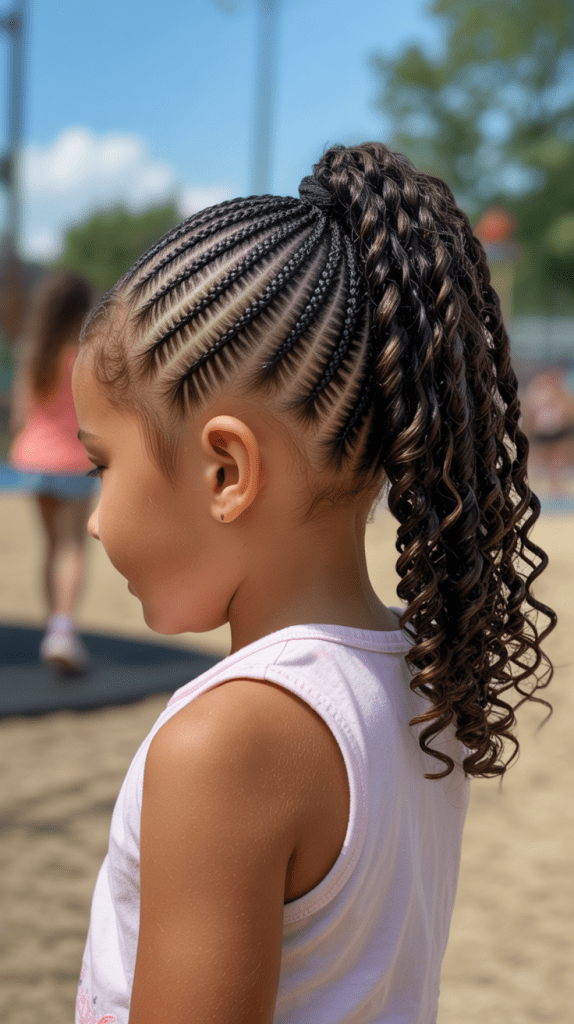
Cornrows into a ponytail combine the security of braided roots with the playful bounce of loose hair.
This popular hybrid style features cornrows that run from the hairline to a designated gathering point, where the remaining hair is secured into a high, mid, or low ponytail.
It’s ideal for children who want length and movement while maintaining a neat, pulled-back foundation.
Construction Process:
- Cornrows are braided from the front and sides, converging at the chosen ponytail location
- The braiding typically stops at the crown for high ponytails or at the nape for low versions
- Remaining natural hair is gathered and secured with a snag-free elastic band
- The ponytail can be left in its natural texture or styled with twists, braids, or curls
- Edge control and gel ensure the cornrowed section remains sleek and polished
Styling Variations:
- Create 2-4 thick cornrows for a bold, statement look with maximum ponytail volume
- Design 6-10 thinner rows for a more intricate, detailed appearance
- Position the ponytail high on the crown for a youthful, energetic vibe
- Place it at the nape for a sophisticated, elegant presentation
- Add a decorative scrunchie or ribbon around the ponytail base for extra flair
7. Curved Cornrow Design
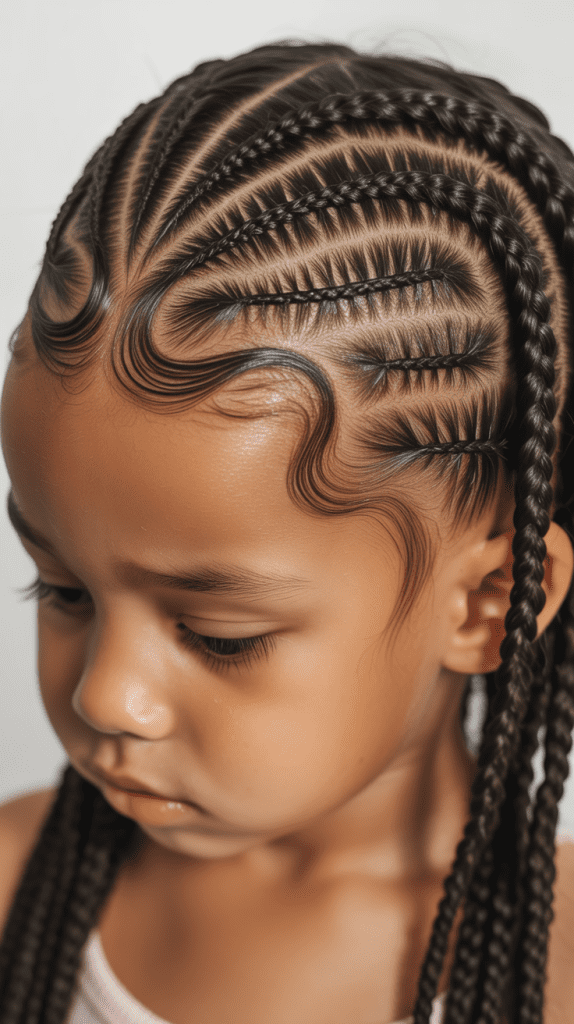
Curved cornrow designs showcase artistic braiding that follows organic, flowing lines rather than straight geometric patterns.
These styles feature cornrows that arc, swirl, and wave across the scalp, creating movement and visual intrigue that captures attention.
The technique requires skilled hands and patience but delivers stunning results that look like wearable art.
Artistic Techniques:
- Braiders create curved lines by adjusting the angle and tension throughout the braiding process
- The curves can be subtle waves or dramatic swoops depending on desired effect
- Multiple curved rows can nest within each other for a layered appearance
- The design often incorporates both left-curving and right-curving lines for balance
- Strategic part placement is crucial for achieving smooth, consistent curves
Visual Impact:
- Curved designs add softness to angular face shapes
- The flowing lines create an illusion of movement even when the hair is static
- This style stands out in photographs and at special events
- Children who prefer organic, natural aesthetics over geometric patterns love these designs
- The curves can follow the natural contours of the head for a customized fit
8. Triangle Box Cornrows
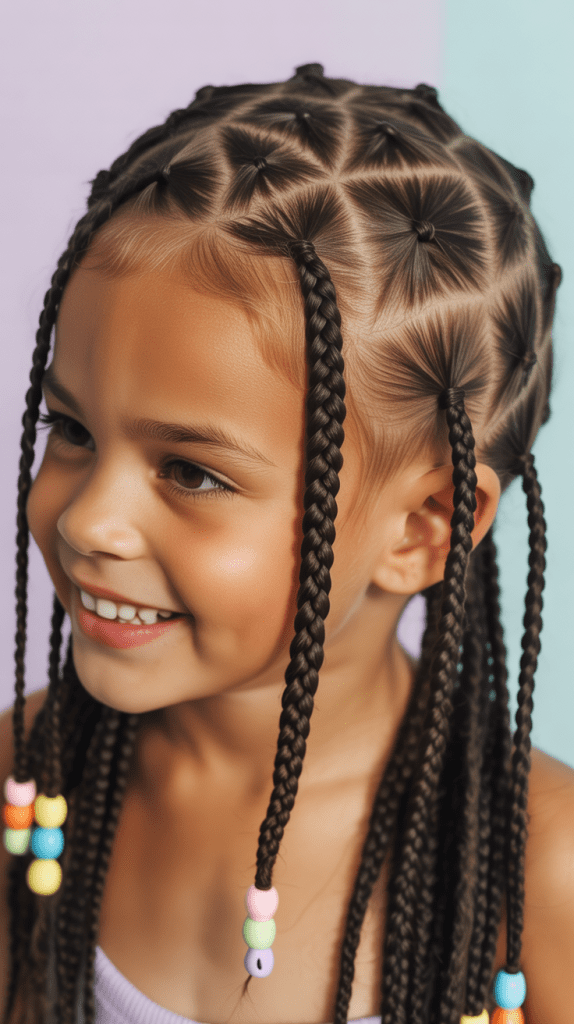
Triangle box cornrows introduce dimensional parting patterns that create visual texture before braiding even begins.
This innovative style divides the scalp into triangular sections rather than traditional rectangular parts, resulting in a unique geometric foundation that makes each cornrow stand out distinctly.
The triangular base also helps reduce tension at the scalp for added comfort.
Geometric Advantages:
- Triangular parts distribute hair more evenly, preventing the thin, stretched look of some rectangular sections
- The varying angles create visual interest and depth across the scalp
- This parting method works exceptionally well for children with thick, dense hair
- Each triangle point can serve as an anchor for decorative beads or accessories
- The pattern remains visible even as the hair grows, extending the style’s lifespan
Technical Considerations:
- Creating uniform triangles requires precision parting and a steady hand
- The braider works in staggered rows rather than parallel lines
- Triangle apexes can point forward, backward, or alternate for different effects
- This technique typically adds 30-45 minutes to the styling time
- The unique parting pattern makes regrowth less noticeable between maintenance appointments
9. Fulani-Inspired Cornrows
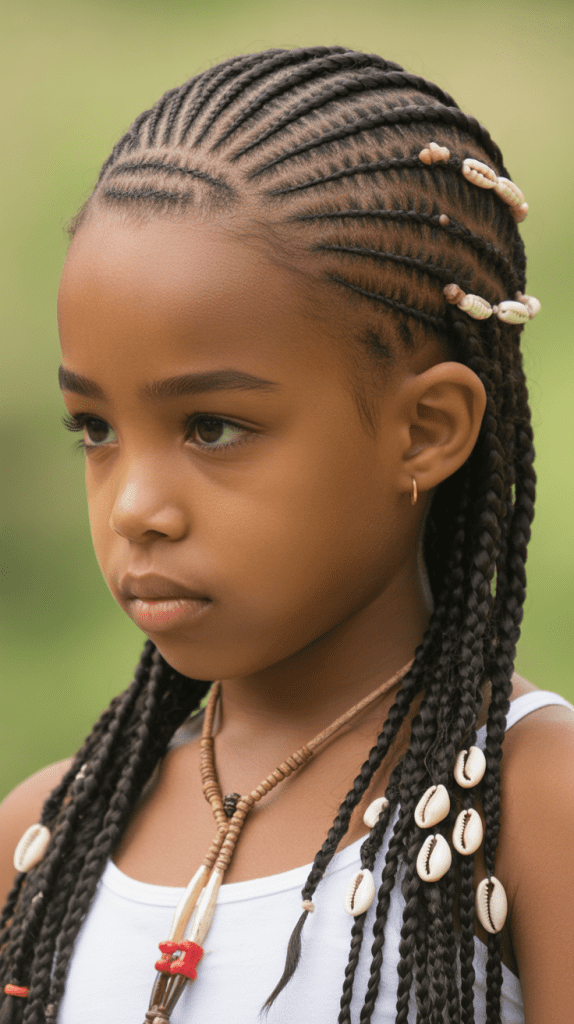
Fulani-inspired cornrows honor the rich braiding traditions of the Fulani people of West Africa.
This culturally significant style typically features a central cornrow or braid running from front to back, flanked by additional cornrows on the sides, often adorned with beads, cowrie shells, or metal accessories.
The design beautifully connects children to their African heritage while providing excellent hair protection.
Cultural Elements:
- The signature center braid is often thicker and more prominent than surrounding cornrows
- Traditional Fulani styles incorporate decorative beads, particularly at the temples
- Cowrie shells symbolize prosperity and protection in many African cultures
- The sides may feature thin cornrows or loose braids that frame the face
- Gold or silver hair cuffs and rings add authentic cultural touches
Modern Adaptations:
- Contemporary versions may simplify the traditional pattern for everyday wear
- Children can choose colors and accessories that reflect their personal style
- The style works beautifully for both casual settings and cultural celebrations
- Parents appreciate teaching children about their heritage through hairstyling choices
- This design has gained mainstream popularity while maintaining its cultural significance
10. Cornrows with Natural Hair Out
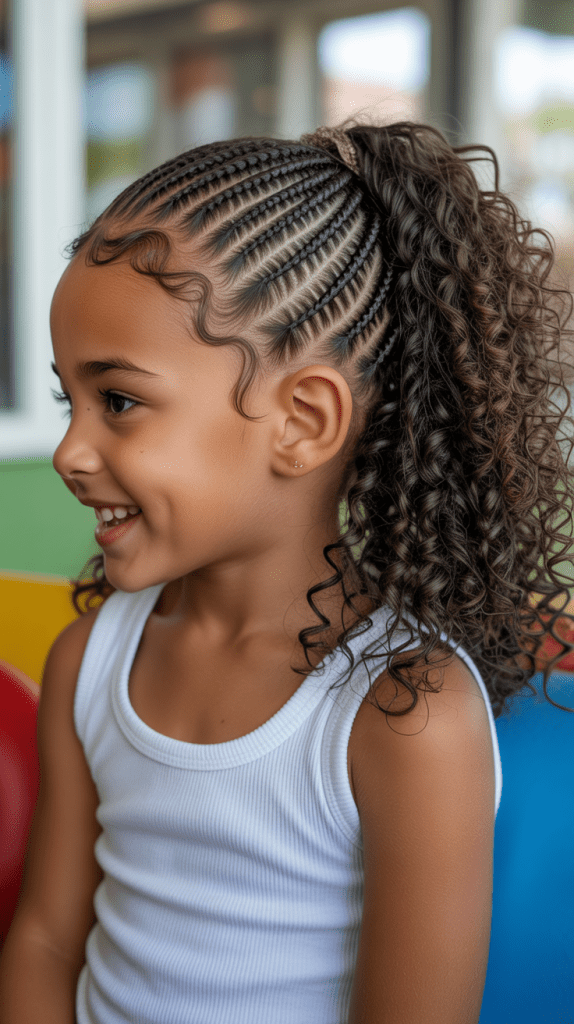
Cornrows with natural hair out create a stunning contrast between sleek, controlled braids and voluminous, free-flowing texture.
This versatile style features cornrows that cover a portion of the scalp—typically the front, sides, or top—while leaving the remaining hair loose in its natural curl pattern.
It’s perfect for children who want protective styling benefits without completely restraining their hair.
Styling Balance:
- The cornrowed section provides structure and keeps hair away from the face
- Loose natural hair maintains volume, movement, and textural interest
- This combination works especially well for children with thick, coily, or kinky hair types
- The style allows for easy transition between protective and free-form looks
- Parents can moisturize and care for the loose section independently
Popular Configurations:
- Front cornrows with a full afro puff or twist-out in the back
- Side cornrows with natural hair cascading over the opposite shoulder
- Crown cornrows creating a halo effect around loose curls
- Temple cornrows that frame the face while the top remains natural
- Nape cornrows with the upper hair left free for maximum volume
11. Criss-Cross Cornrows
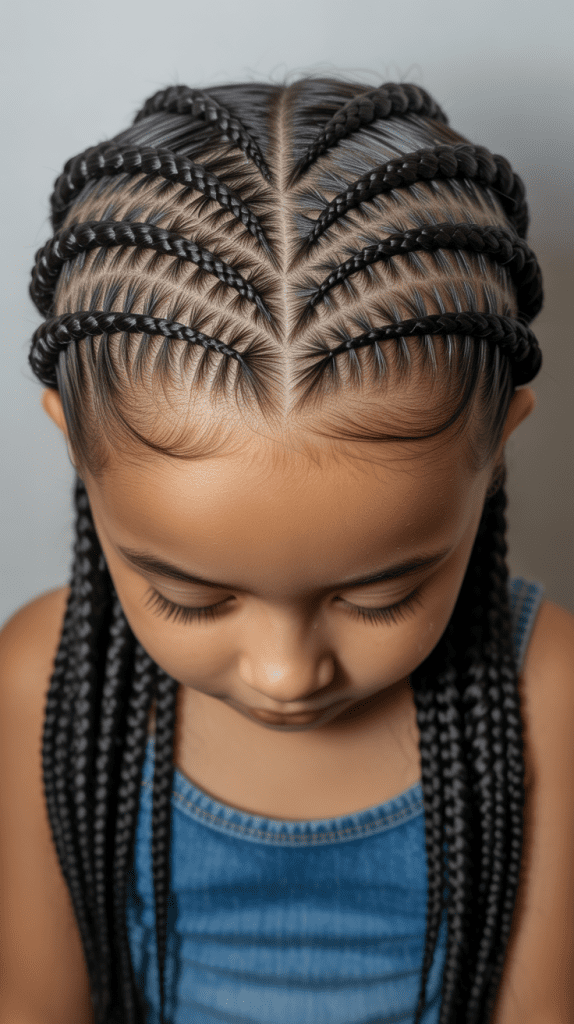
Criss-cross cornrows feature intersecting braids that weave over and under each other, creating an intricate lattice pattern across the scalp.
This advanced braiding technique produces a three-dimensional effect that appears complex and artistic, making it ideal for children attending special events or who simply love showing off unique hairstyles.
The woven appearance catches light beautifully and photographs exceptionally well.
Weaving Technique:
- Braiders create the pattern by stopping and starting cornrows at strategic intersection points
- Some sections braid over while others tuck under, mimicking basket-weaving techniques
- The design requires careful planning to ensure balanced symmetry
- Tension must be carefully controlled to prevent discomfort where braids cross
- The completed style showcases depth and dimension impossible with simple parallel rows
Design Possibilities:
- Simple two-braid criss-cross patterns work well for braiding beginners
- Complex multi-directional weaves create stunning visual complexity
- The intersections can be marked with decorative beads or accessories
- Some designs incorporate both thick and thin cornrows for textural variation
- The pattern can cover the entire head or accent specific sections
12. Mohawk Cornrow Style
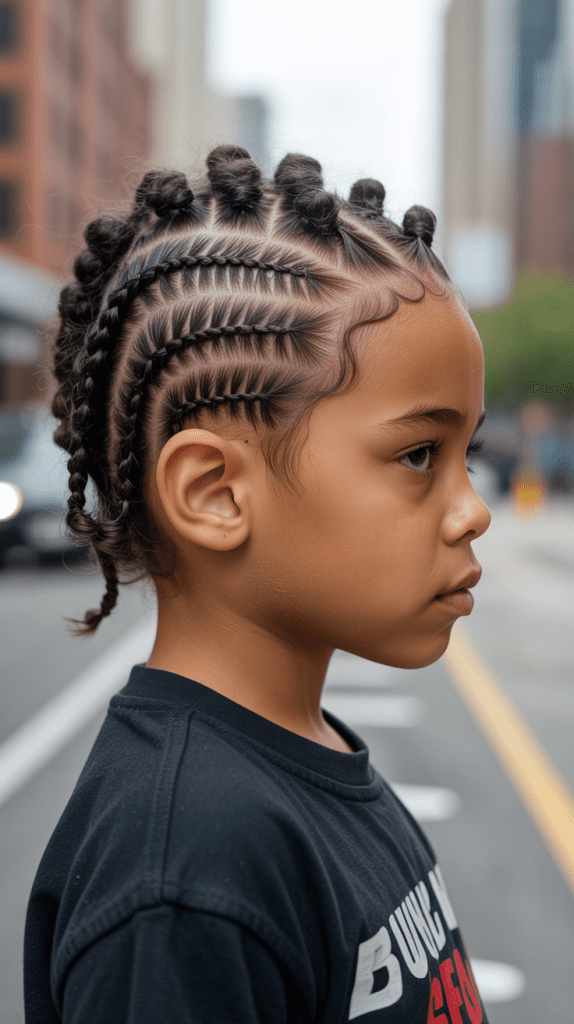
Mohawk cornrow styles deliver bold, edgy attitude while maintaining the protective benefits of braiding.
This striking design features cornrows on both sides of the head that angle upward toward the center, creating a raised ridge of braids or natural hair along the crown.
It’s perfect for confident children who aren’t afraid to stand out and make a statement with their hair.
Construction Variations:
- Side cornrows can be thin and numerous or thick and bold depending on preference
- The center section might consist of upward-pointing cornrows, a braided ridge, or loose natural hair
- Some versions feature completely flat sides with dramatic volume at the crown
- The mohawk height can be subtle for everyday wear or exaggerated for special occasions
- Color accents along the center ridge add extra visual punch
Personality Expression:
- This style appeals to creative, artistic children who embrace individuality
- The bold silhouette photographs dramatically and makes a strong impression
- Parents appreciate that it’s a temporary way for children to experiment with edgy looks
- The design works for all hair textures and lengths with proper technique
- Children often receive compliments and positive attention for this confident style choice
13. Feed-in Cornrows
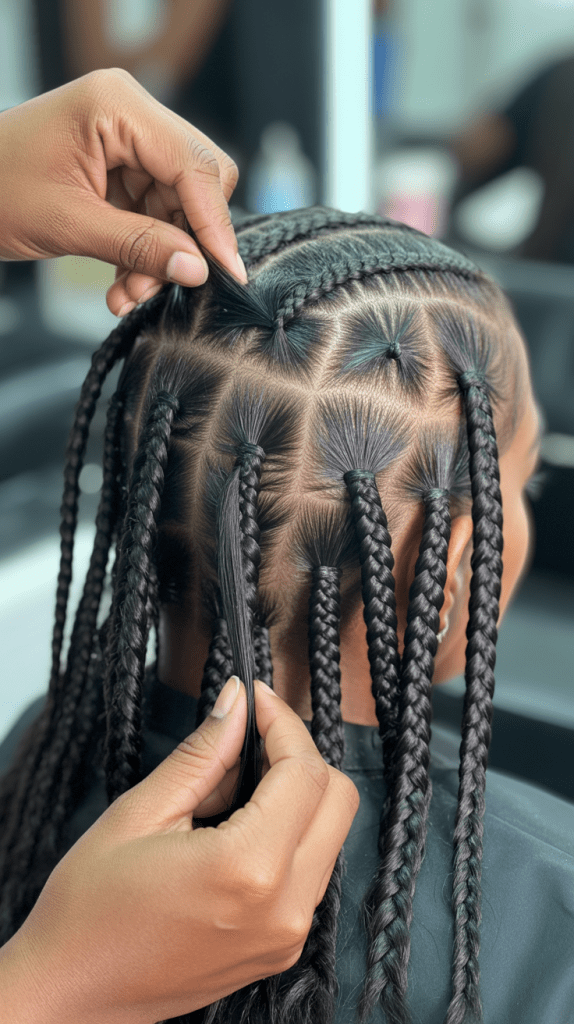
Feed-in cornrows utilize a gradual hair addition technique that creates incredibly natural-looking braids without excessive tension at the roots.
This method involves starting each cornrow with the child’s natural hair and progressively adding small amounts of extension hair as the braid continues, resulting in seamlessly thin-to-thick transitions.
It’s one of the healthiest braiding approaches for children’s delicate scalps and hairlines.
Technical Advantages:
- The gradual feed-in method distributes weight evenly along the entire braid length
- This technique significantly reduces stress on the hairline and prevents traction alopecia
- The braids appear to emerge naturally from the scalp rather than starting thick and bulky
- Children experience less discomfort and tension headaches compared to traditional methods
- The style typically lasts longer because the lightweight roots experience less pulling
Application Process:
- Braiders begin with only the child’s natural hair at the root
- Small sections of extension hair are incorporated incrementally with each stitch
- The additions are so gradual that transitions become virtually invisible
- Different extension lengths allow for customized final braid lengths
- Proper edge control application ensures clean, defined parts throughout
14. Cornrows with Twists at the Ends
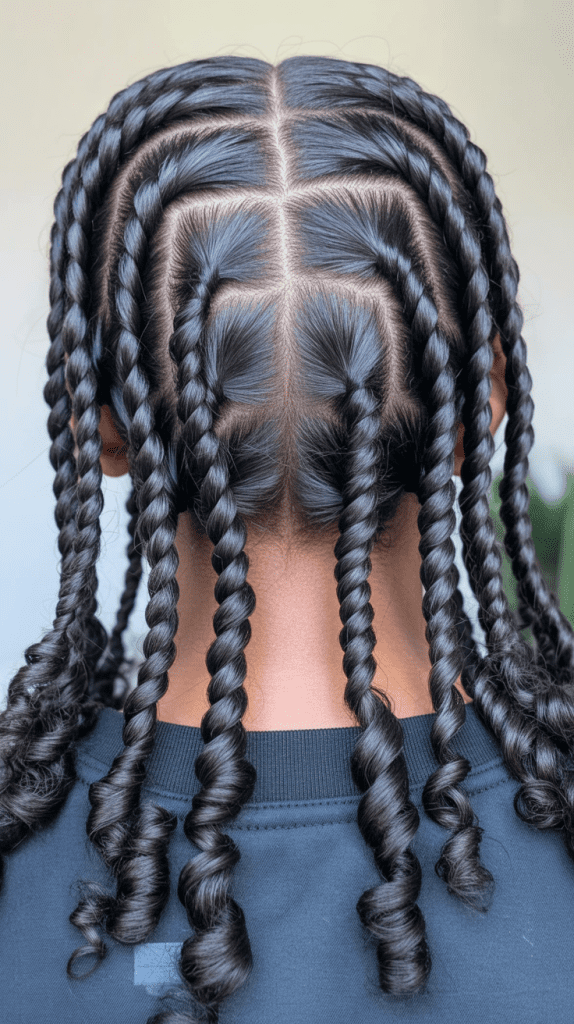
Cornrows with twists at the ends combine two popular protective styling techniques into one cohesive look.
This creative approach features traditional cornrows that extend to a certain point on the scalp, where the braiding stops and the remaining hair is divided and twisted into two-strand twists.
The combination offers textural variety and allows for beautiful curly ends when the twists are eventually unraveled.
Dual-Technique Benefits:
- The cornrowed section provides security and longevity near the roots
- Twists at the ends are gentler on fragile hair tips than continued tight braiding
- This method works exceptionally well for children with varying hair textures throughout their length
- The twisted ends create natural-looking curl definition when taken down
- Parents find maintenance easier since twists can be redone without completely restyling the cornrows
Styling Flexibility:
- The twist section length can vary from a few inches to the majority of the hair length
- Chunky twists create bold, statement ends while micro-twists offer subtle elegance
- The twisted portions can be styled into updos, ponytails, or left hanging freely
- Adding oils or moisturizers to the twist section is simple without disturbing the cornrows
- Children enjoy the bouncier, more mobile feeling of twisted ends compared to fully braided hair
15. Halo Cornrow Braid
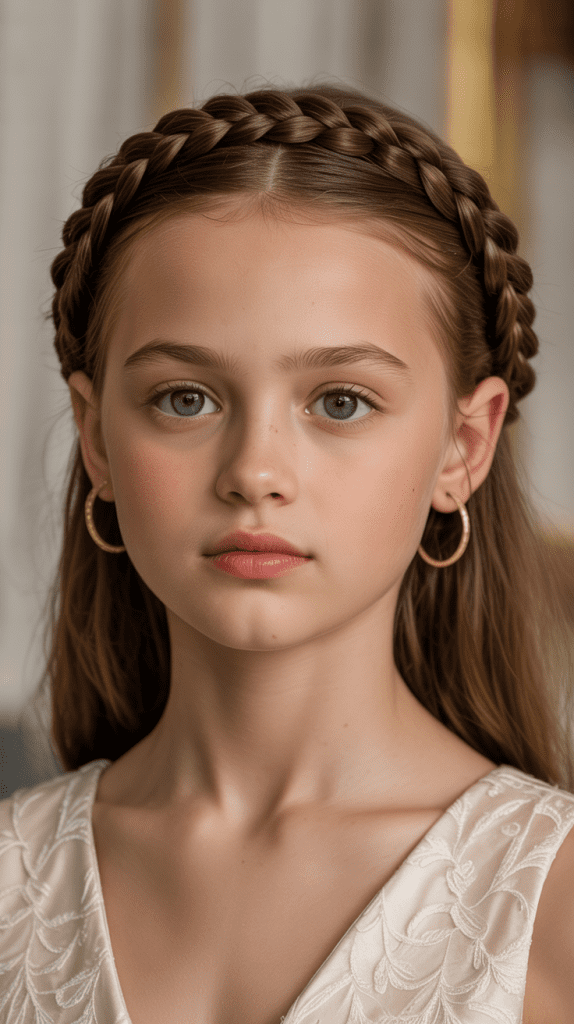
The halo cornrow braid creates an angelic, crown-like effect by braiding cornrows in a circular pattern around the head’s perimeter.
This elegant style keeps all hair secured close to the scalp while framing the face beautifully, making it perfect for formal occasions, religious ceremonies, or simply making your child feel like royalty.
The continuous circular pattern eliminates the need for visible starting or stopping points.
Circular Construction:
- The braid follows the natural hairline around the entire head circumference
- Skilled braiders create seamless connections where the cornrow ends meet the beginning
- The style can feature a single thick halo braid or multiple concentric circles
- Hair in the center crown area can be left natural, braided flat, or styled into a bun
- The circular pattern distributes tension evenly, making it comfortable for extended wear
Elegant Applications:
- This style is popular for flower girls at weddings and children in formal portraits
- Religious and cultural ceremonies often feature halo braids as traditional appropriate styling
- The symmetrical, balanced appearance complements formal attire perfectly
- Decorative flowers, ribbons, or jeweled pins can be added along the halo for enhancement
- The style keeps hair completely secured without any loose pieces falling into the face
16. Cornrows with a Top Knot
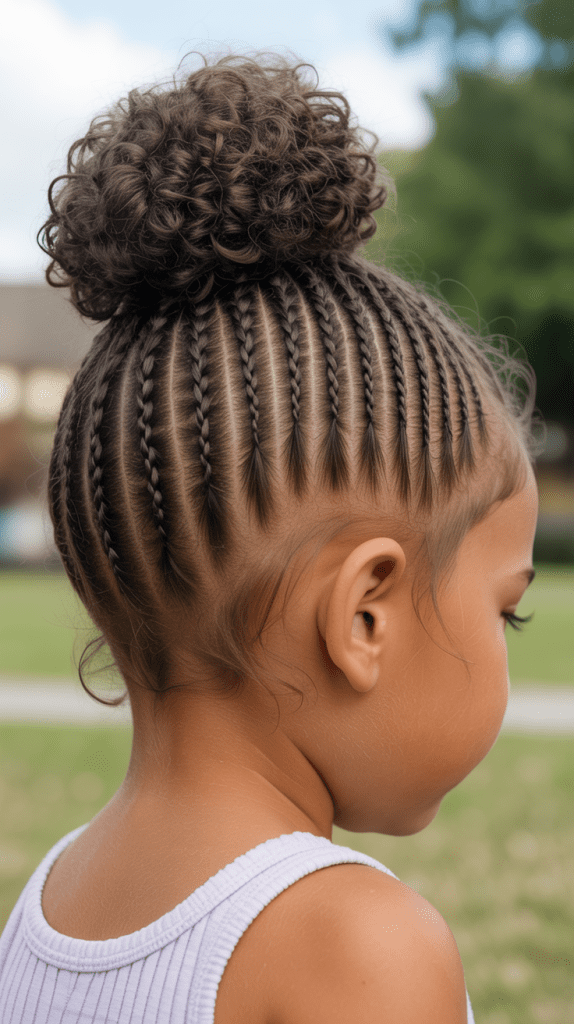
Cornrows with a top knot combine practical protective styling with trendy, fashion-forward aesthetics.
This popular design features cornrows that run from the hairline upward, converging at the crown where the remaining hair is gathered into a knot, bun, or puff.
The elevated topknot adds height and drama while the cornrowed base ensures longevity and low maintenance.
Structural Design:
- Cornrows typically begin at the front hairline and temples, braiding toward the crown
- The braiding stops at a predetermined gathering point where the topknot will sit
- The loose hair section can be twisted, braided, or left in its natural texture before knotting
- Topknot size varies from sleek, tight ballerina buns to full, voluminous puffs
- The number of cornrows can range from just two or three to eight or more for different effects
Style Versatility:
- High topknots create a playful, youthful appearance perfect for active children
- Lower, more centered knots offer sophistication suitable for various settings
- The natural texture of the knot can be enhanced with curl-defining products
- Accessories like scrunchies, ribbons, or decorative pins personalize the look
- This combination works for children with medium to long natural hair lengths
17. Lemonade Braids
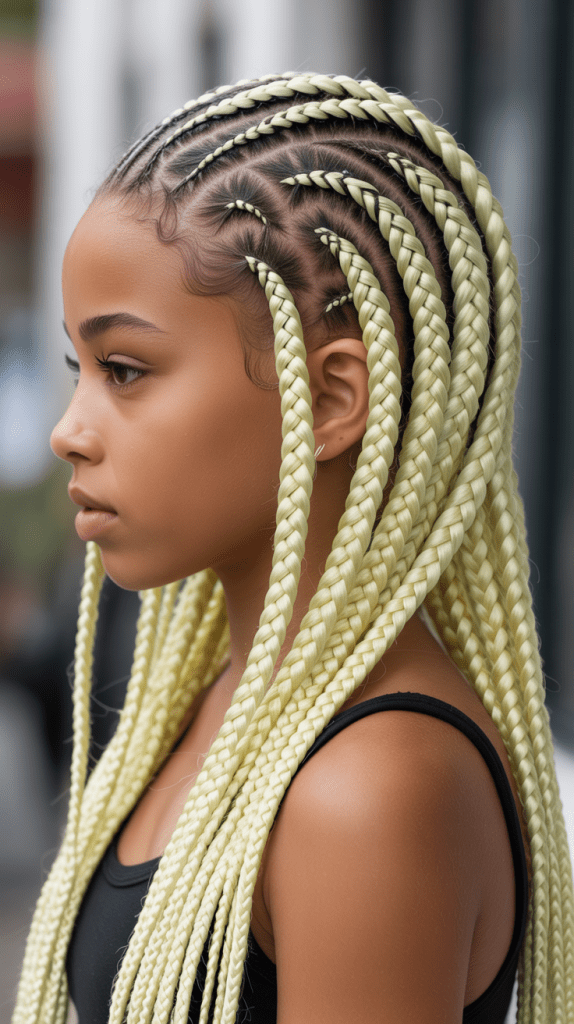
Lemonade braids gained iconic status and their name from Beyoncé’s visual album “Lemonade,” where she showcased this distinctive side-swept cornrow style.
This trending design features long, neat cornrows that sweep from one side of the head to the other in a diagonal pattern, often extending well past the shoulders.
The style has become a cultural phenomenon, particularly popular among young girls who admire the look’s sleek elegance and celebrity association.
Signature Characteristics:
- All braids flow uniformly in one diagonal direction, typically from left to right or vice versa
- The cornrows are usually medium-sized, creating a balanced look between thin and chunky
- The style works best with added braiding hair for length, fullness, and durability
- The dramatic side sweep creates an asymmetrical appearance that’s both edgy and elegant
- The long length allows for various styling options including high ponytails and half-up styles
Maintenance Requirements:
- Regular scalp moisturizing prevents dryness along the diagonal part lines
- The extended length requires nightly protection with a satin bonnet or pillowcase
- Edge control application keeps the starting points neat and defined
- The style typically lasts 4-6 weeks with proper care and maintenance
- Children should avoid excessive manipulation of the long braids to prevent frizzing
18. Cornrows in Circular Patterns
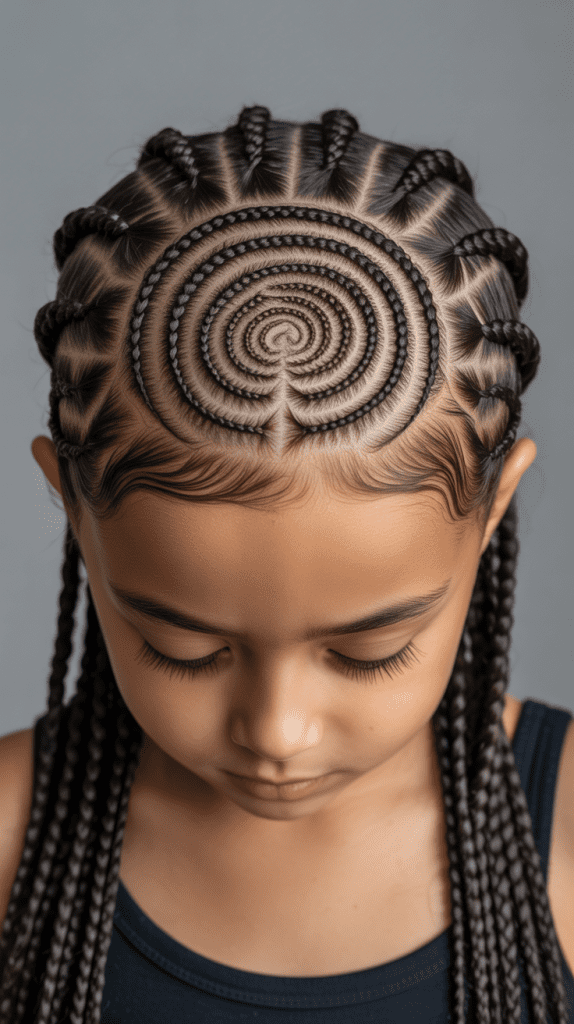
Cornrows in circular patterns create mesmerizing spiral designs that radiate from a central point or multiple focal areas.
These artistic styles showcase advanced braiding techniques where cornrows curve continuously in circular or spiral formations, creating mandala-like effects across the scalp.
The design appeals to children who appreciate symmetry, geometry, and truly unique hairstyles that few others wear.
Geometric Precision:
- The central starting point serves as the anchor from which all circles radiate
- Braiders work in a rotational motion, gradually increasing the circle diameter
- Multiple spiral centers can be strategically placed for complex, interconnected patterns
- The design requires exceptional part precision to maintain uniform circular shapes
- Smaller circles can nest within larger ones for layered, dimensional effects
Artistic Expression:
- The spiral pattern has cultural significance in many African and indigenous traditions
- The mesmerizing design creates a hypnotic visual effect that captures attention
- This style works beautifully for children with round face shapes, complementing their features
- The continuous flowing lines suggest movement and energy even in still photographs
- Parents often choose this for special occasions where artistic presentation matters
19. Cornrows with Bantu Knots
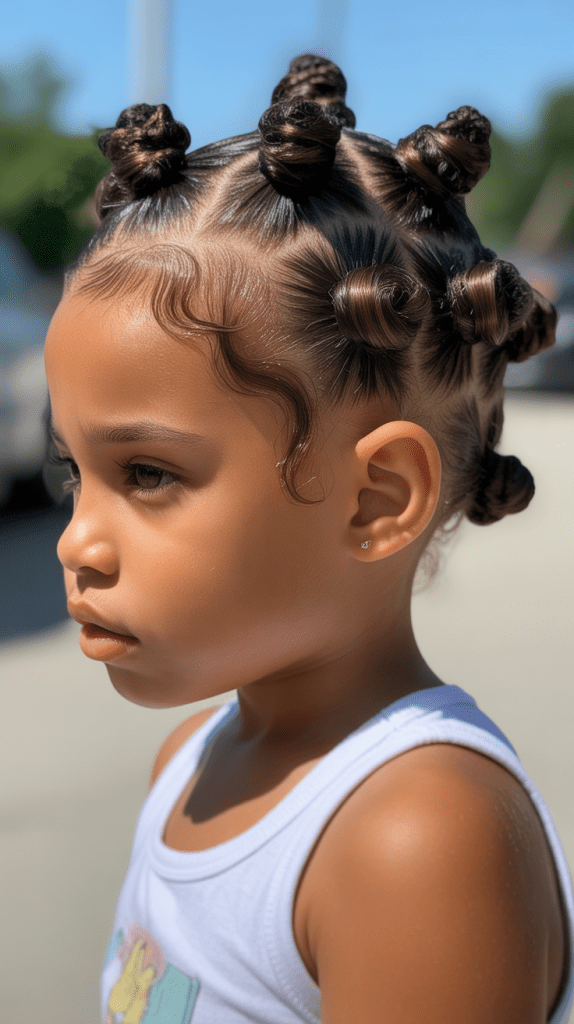
Cornrows with Bantu knots blend two iconic African hairstyling techniques into one stunning protective style.
This combination features cornrows covering sections of the scalp, while other sections showcase Bantu knots—small, coiled buns created by twisting hair and wrapping it around itself.
The mix of linear braided texture and sculptural rounded knots creates dynamic visual contrast and cultural celebration.
Cultural Heritage:
- Bantu knots originate from the Zulu people of Southern Africa, carrying deep historical significance
- The style honors traditional African hair artistry while adapting it for contemporary wear
- Both cornrows and Bantu knots serve as protective styles that promote hair health
- The combination represents a beautiful expression of cultural pride and identity
- Many parents use this opportunity to educate children about their heritage
Design Combinations:
- Common layouts include cornrows on the sides with Bantu knots across the crown
- Alternating patterns of rows and knots create checkerboard-like effects
- The knots can vary in size from tiny miniature versions to large, statement pieces
- When unraveled, Bantu knots create beautiful defined curls for versatile second-day styling
- The combination typically lasts 1-2 weeks before knots begin to loosen
20. Ladder Braid Cornrows
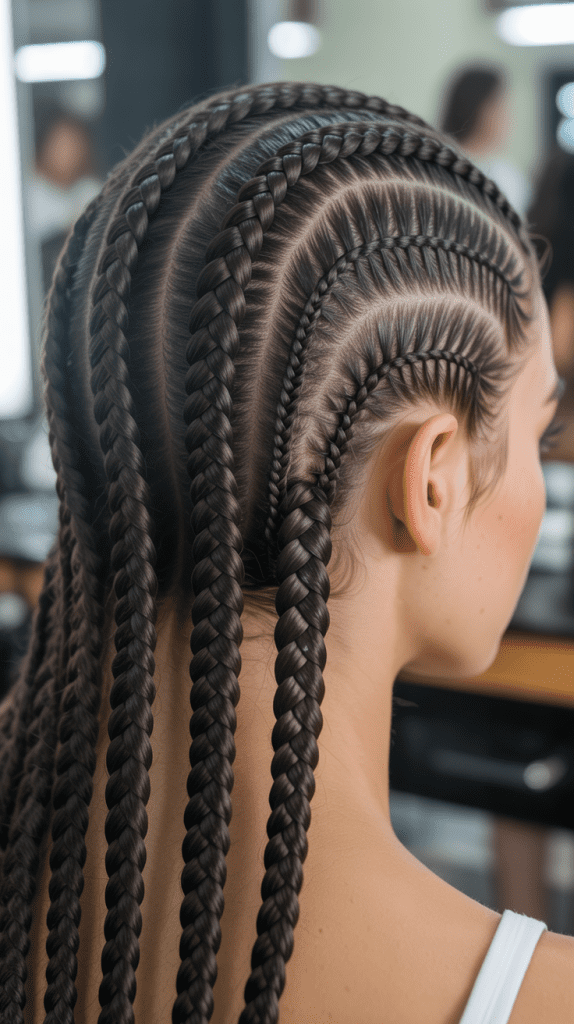
Ladder braid cornrows create the optical illusion of horizontal rungs connecting vertical braided “rails,” mimicking the structure of a ladder.
This intricate design involves weaving small sections of hair between parallel cornrows to create connecting bridges, resulting in a complex geometric pattern that requires advanced braiding skills.
The style is perfect for children attending special events where they want a truly distinctive look.
Technical Construction:
- Two parallel cornrows serve as the vertical “rails” of the ladder structure
- Small sections of hair from each rail are crossed and woven to form horizontal “rungs”
- The connecting sections must be carefully tensioned to maintain the ladder appearance
- This design works best on hair that’s at least 4-5 inches long for proper manipulation
- The pattern can be created as a single focal ladder or multiple ladders across the scalp
Visual Drama:
- The interconnected design creates impressive three-dimensional depth
- Light catches the raised connecting sections, enhancing the sculptural quality
- This style generates numerous compliments and conversation at social gatherings
- The complexity signals the time and skill invested in the child’s hair care
- Photographs of this design often become treasured memories of childhood styling adventures
21. Cornrow Updo
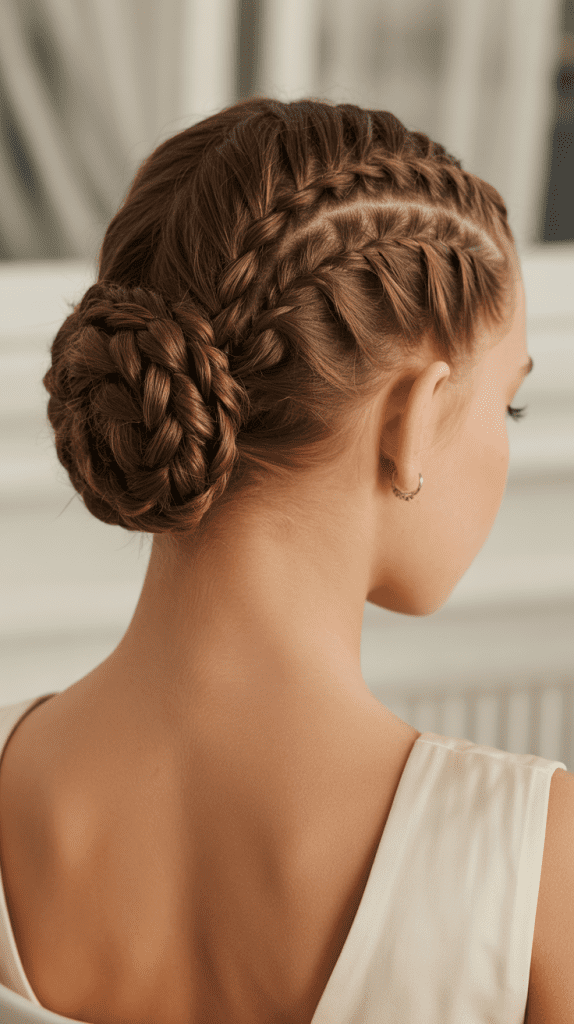
Cornrow updos elevate protective styling to formal elegance by incorporating braided rows into sophisticated pinned arrangements.
These styles feature cornrows that are strategically braided and then tucked, twisted, or pinned into elevated designs at the back or top of the head.
The updo approach keeps hair completely secured while creating polished looks suitable for the most formal occasions.
Elegant Configurations:
- Cornrows can spiral into a central bun at the crown for classic sophistication
- Braids may be folded and pinned into rose or flower-like shapes for romantic effects
- Some designs feature cornrows that transition into twisted or rolled sections before pinning
- The nape area often receives special attention with decorative cornrow patterns leading upward
- Height and volume can be adjusted based on the formality of the occasion
Special Occasion Styling:
- These updos are popular for weddings, quinceañeras, and formal religious ceremonies
- The secured nature ensures the style remains intact through long events and activities
- Decorative pins, flowers, or jeweled accessories can be added for extra embellishment
- The elegant appearance helps children feel confident in formal photographs
- Parents appreciate that these styles withstand dancing, playing, and other celebration activities
22. Micro Cornrows
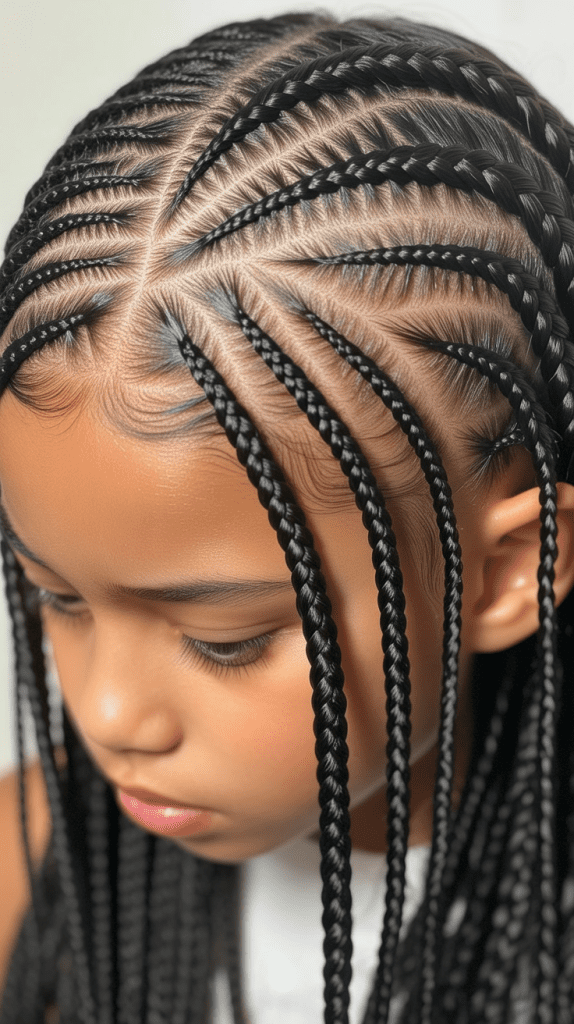
Micro cornrows showcase incredible precision through dozens of ultra-thin braided rows that create sleek, intricate scalp patterns.
This labor-intensive style involves braiding hair into very fine sections, typically resulting in anywhere from 20 to 50+ individual cornrows depending on hair density and desired effect.
The refined appearance appeals to children and parents who appreciate detailed artistry and extended style longevity.
Precision Characteristics:
- Each cornrow measures only 1-5mm in width, requiring exceptional braiding skill
- The multitude of rows creates a sleek, almost painted-on appearance
- This style provides maximum scalp visibility, making it easier to apply moisturizers
- The thin sections reduce bulk, making the overall style lighter and more comfortable
- Micro cornrows can be arranged in straight patterns or complex geometric designs
Duration Considerations:
- Installation typically requires 3-6 hours depending on the number of rows and complexity
- The style lasts exceptionally long—often 4-8 weeks with proper maintenance
- The extended wear time makes the initial time investment worthwhile
- Daily maintenance is minimal, requiring only light oil application and bonnet wearing
- The fine size means less manipulation stress on individual hair strands
23. Jumbo Cornrows
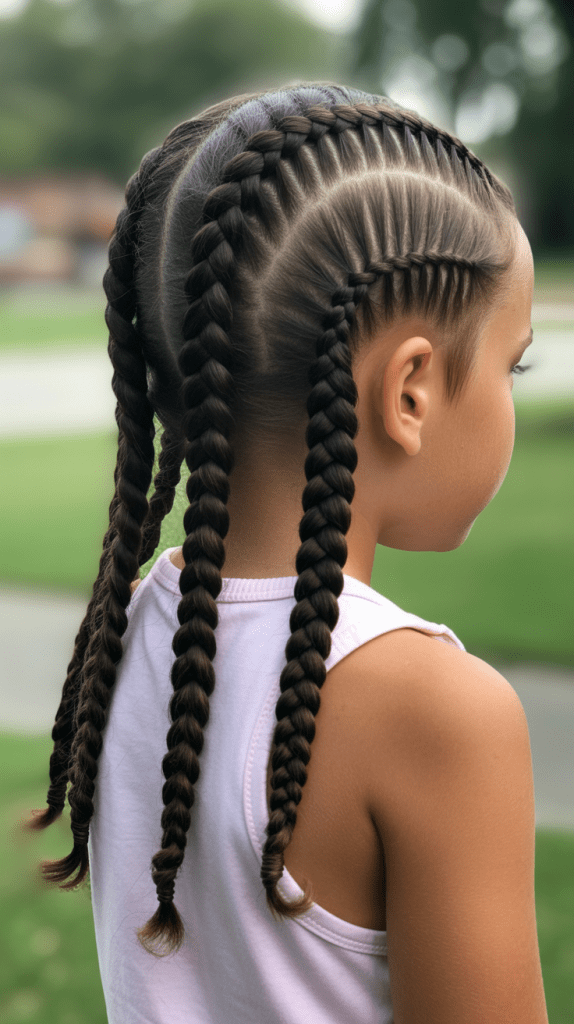
Jumbo cornrows take the opposite approach from micro braids, featuring thick, bold cornrows that make dramatic statements.
This style typically consists of 4-8 large braided rows that stand out prominently and reduce styling time significantly.
Jumbo cornrows are perfect for children who want a bold look, parents short on time, or situations where quick protective styling is needed.
Bold Features:
- Each cornrow measures 1-2 inches wide, creating substantial visual impact
- The reduced number of rows means significantly shorter installation time—often just 1-2 hours
- The chunky appearance works particularly well for children with thick, dense natural hair
- Large sections are easier for braiding beginners to manage and practice with
- The bold scale suits confident personalities and makes strong fashion statements
Practical Benefits:
- Less time in the braiding chair means more comfortable experiences for fidgety children
- The larger sections experience less tension individually, promoting scalp comfort
- Maintenance is simplified with fewer rows to oil and care for
- The style still provides excellent hair protection despite the larger size
- Jumbo cornrows work well as bases for other styles like high ponytails or buns
24. Cornrows with Colored Extensions
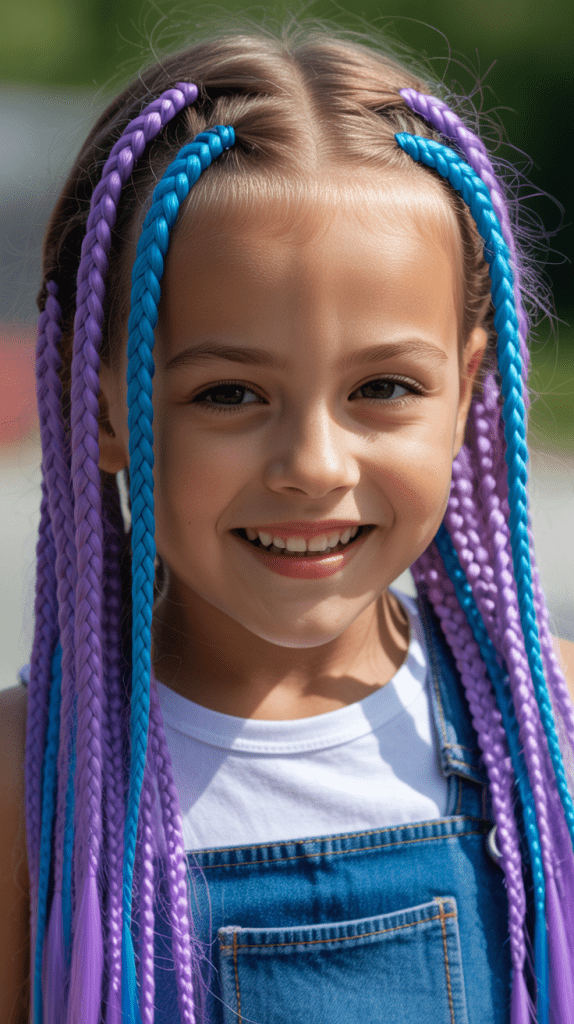
Cornrows with colored extensions inject vibrant personality and creativity into traditional protective styling.
This playful approach incorporates synthetic braiding hair in various colors—from subtle highlights to bold rainbow hues—woven into the cornrows.
The color additions allow children to experiment with different looks without chemical dyes, making it a safe and temporary way to embrace colorful self-expression.
Color Selection:
- Popular choices include bright primary colors like pink, purple, blue, and green
- Ombre effects transition from natural hair color to vivid tips
- Multi-colored combinations create rainbow or tie-dye effects
- Metallic and neon shades offer ultra-modern, attention-grabbing options
- Some parents opt for school colors to show team spirit during sports seasons
Application Methods:
- Colored extensions are incorporated using the feed-in technique for natural blending
- Colors can be added to all cornrows for full coverage or strategically to specific rows
- The synthetic hair holds color vibrantly without bleeding or fading
- Different colors can be assigned to different sections for patterned effects
- The extensions come in various textures to match different natural hair types
Safety and Maintenance:
- Synthetic colored extensions avoid chemical damage from permanent dyes
- The temporary nature allows children to change colors as trends and preferences evolve
- Regular moisturizing prevents the synthetic hair from becoming dry and brittle
- The colorful appearance requires careful clothing coordination to avoid clashing
- Most colored extensions maintain vibrancy for the entire 2-4 week wear period without special treatment
25. Tribal Cornrow Patterns
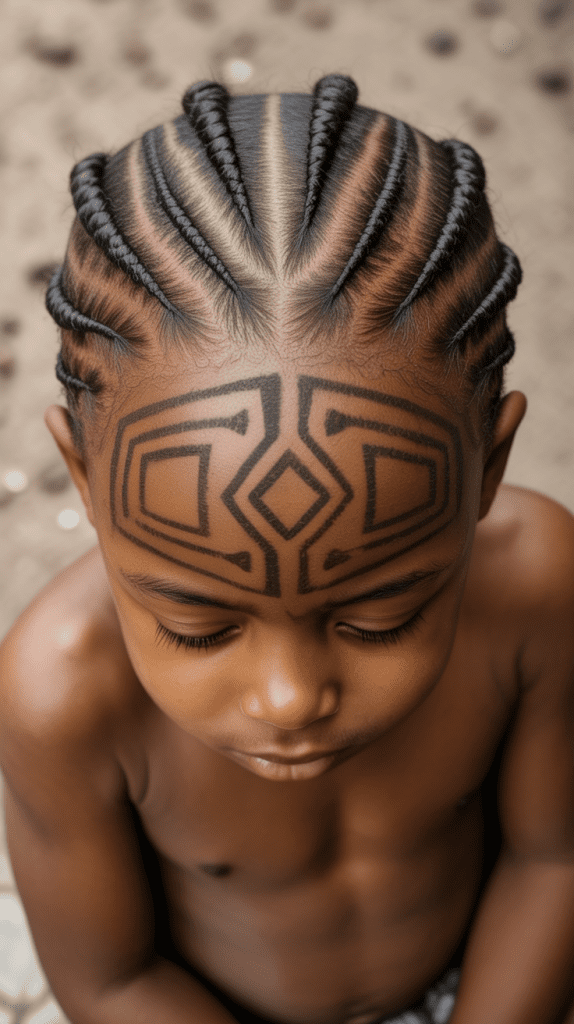
Tribal cornrow patterns pay homage to traditional African braiding designs that have been passed down through generations.
These styles feature specific geometric configurations, symbols, and arrangements that hold cultural significance and tell stories through hair artistry.
The patterns connect children to their ancestral roots while providing beautiful, meaningful protective styling.
Cultural Significance:
- Different tribal communities developed distinctive braiding patterns for identification and status
- Specific designs historically indicated age, marital status, wealth, or tribal affiliation
- The intricate patterns demonstrate respect for traditional African hair artistry
- Many designs incorporate symbols representing protection, fertility, or spiritual beliefs
- Learning these patterns helps preserve cultural heritage for future generations
Pattern Variations:
- Angular geometric shapes reflect traditional African art and architecture
- Symmetrical designs emphasize balance and harmony valued in many cultures
- Some patterns incorporate specific numbers of braids with symbolic meanings
- The complexity level varies from simple traditional arrangements to highly intricate designs
- Modern interpretations may adapt historical patterns for contemporary aesthetics
Educational Value:
- Parents use styling sessions to teach children about their cultural history
- The visible nature of hair art makes it an accessible entry point for heritage discussions
- Children gain pride and confidence through connection to their ancestral traditions
- The styles can spark conversations and education in diverse community settings
- Wearing tribal patterns becomes a celebration of identity and cultural continuity
26. Cornrows with Side Braid
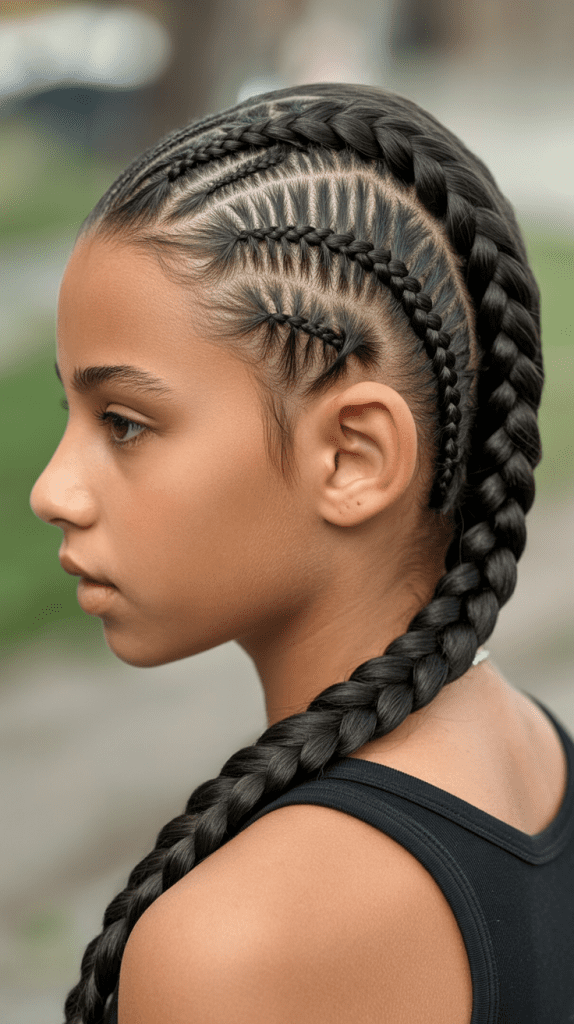
Cornrows with side braid combine structured scalp braiding with a flowing accent braid that cascades over one shoulder.
This asymmetrical style typically features multiple cornrows on one or both sides of the head, with a single larger braid left loose to hang freely as a decorative element.
The combination offers the security of cornrows with the movement and versatility of a traditional braid.
Design Structure:
- The side braid usually begins at the temple or behind the ear
- Cornrows on the opposite side create contrast and draw attention to the accent braid
- The loose braid can be left as a simple three-strand or styled as a fishtail, Dutch, or French braid
- Some designs incorporate the side braid into the cornrow pattern at strategic points
- The free-hanging braid can be adorned with beads, ribbons, or hair jewelry
Styling Flexibility:
- The side braid can be worn forward over the shoulder or back behind it
- Children can manipulate and restyle the loose braid without disturbing the cornrows
- The accent braid provides a focal point that balances the secured cornrow sections
- This style works for various hair lengths, from medium to very long
- The combination suits both casual everyday wear and more formal occasions
27. Crown Cornrows
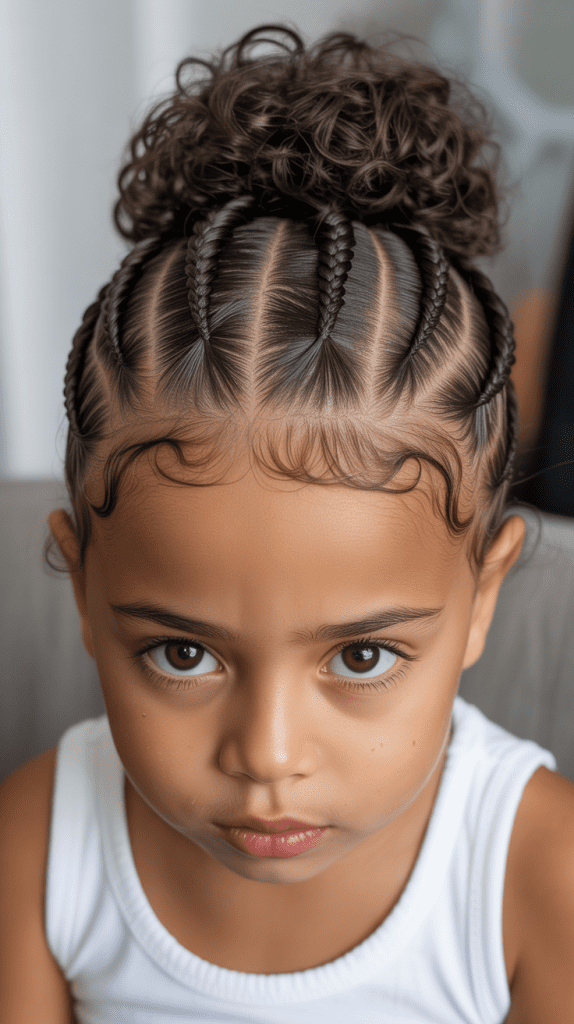
Crown cornrows create a regal circular braiding pattern that sits like a royal headpiece around the upper portion of the head.
This elegant style features cornrows that follow the natural curve of the crown area, often leaving the center section open for creative styling options.
The circular arrangement frames the face beautifully while providing secure, long-lasting protection.
Royal Aesthetic:
- The circular pattern mimics the appearance of a decorative crown or tiara
- Braids can be uniform in size or graduate from thin to thick for dimensional effect
- The center area can be styled into a puff, bun, twisted updo, or left with free-flowing curls
- Some versions incorporate multiple concentric circles for layered crown effects
- The design naturally draws the eye upward, creating an elegant lifted appearance
Versatile Center Styling:
- A high puff in the center creates volume and drama perfect for special occasions
- Twist-outs or braid-outs in the middle section provide textured, defined curls
- A sleek bun offers polished sophistication for formal events
- Free natural curls in the center celebrate texture while maintaining perimeter control
- The center can be restyled multiple times without redoing the crown cornrows
28. Cornrows with Hair Jewelry
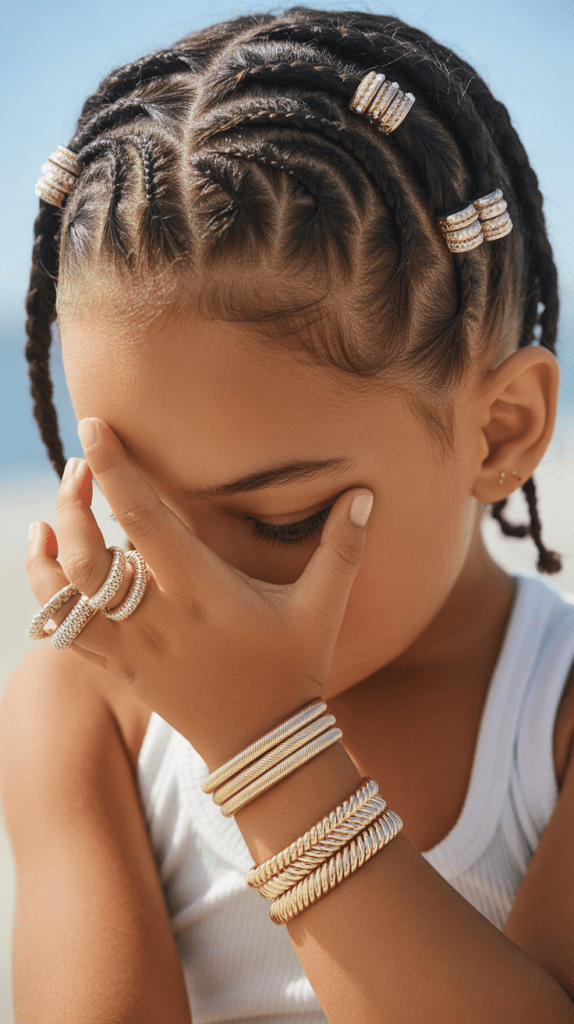
Cornrows with hair jewelry transform protective styling into wearable art through carefully selected metallic accessories.
This decorative approach incorporates rings, cuffs, chains, and charms threaded onto or clipped into cornrows, adding shimmer, texture, and personal style.
The jewelry elements elevate simple braids into statement pieces perfect for fashion-forward children.
Jewelry Options:
- Metal hair cuffs slide onto individual braids and stay secure through friction
- Hair rings come in various sizes and can be stacked along braid lengths
- Decorative chains connect between cornrows creating intricate linking patterns
- Charms and pendants add personalized touches reflecting the child’s interests
- Gold, silver, rose gold, and colorful metallic finishes suit different style preferences
Application Techniques:
- Cuffs are best applied to braids of medium thickness for secure fit
- Multiple rings placed at intervals create rhythm and visual interest
- Chains require careful spacing between cornrows to drape properly without pulling
- Jewelry placement should avoid excessive weight at any single point
- All pieces should have smooth interiors to prevent hair breakage
Style Impact:
- The metallic accents catch light beautifully in photographs and videos
- Jewelry additions work for both casual trendy looks and formal elegant presentations
- Children enjoy the customizable nature and ability to add or remove pieces
- The accessories make hair styling feel special and celebratory
- Hair jewelry serves as age-appropriate introduction to fashion accessorizing
29. Geometric Cornrow Design
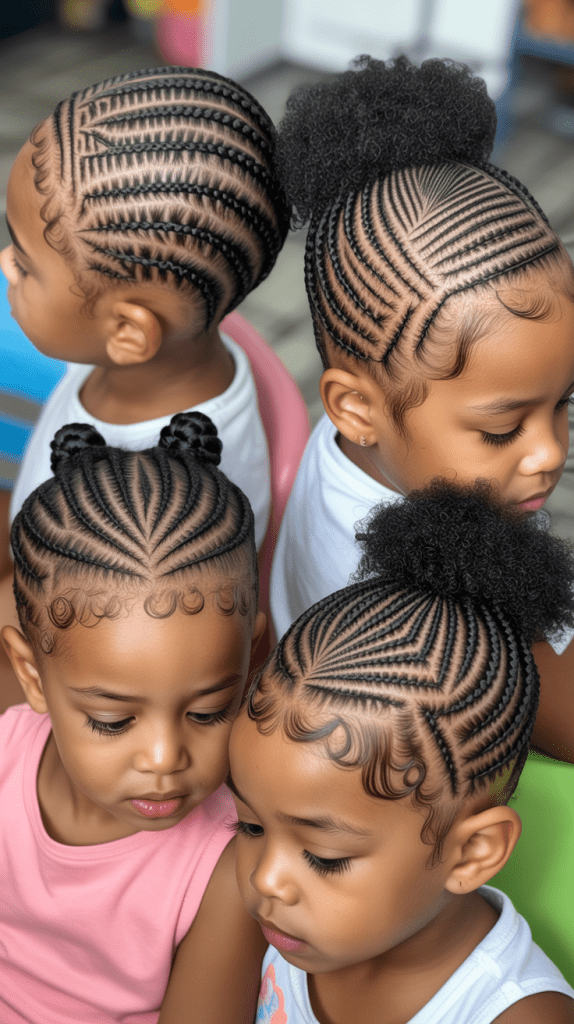
Geometric cornrow designs showcase mathematical precision through perfectly aligned shapes, angles, and symmetrical patterns.
These artistic styles feature cornrows arranged to create triangles, diamonds, hexagons, or other geometric forms across the scalp.
The structured appearance appeals to children who appreciate order, symmetry, and visually striking hairstyles that demonstrate technical skill.
Shape Formations:
- Triangle patterns can point upward, downward, or alternate directions for visual rhythm
- Diamond shapes create sophisticated checkerboard-like effects across the scalp
- Hexagonal honeycomb patterns demonstrate advanced planning and execution
- Square and rectangular grids offer clean, modern aesthetic appeal
- Mixed geometric shapes create complex, puzzle-like arrangements
Technical Precision:
- Creating uniform shapes requires careful measurement and precise parting
- Angles must be exact to maintain geometric integrity throughout the design
- The mathematical nature of these patterns appeals to analytical, detail-oriented personalities
- Templates or guides may be used initially to ensure accuracy
- The clean lines photograph exceptionally well for documentation and social sharing
Visual Mathematics:
- These styles can serve as engaging visual aids for teaching geometry concepts
- Children develop appreciation for mathematical beauty through wearable art
- The structured patterns complement academic settings and school environments
- The precise nature demonstrates discipline and attention to detail
- Geometric designs remain contemporary and modern in aesthetic appeal
30. Cornrows into Box Braids
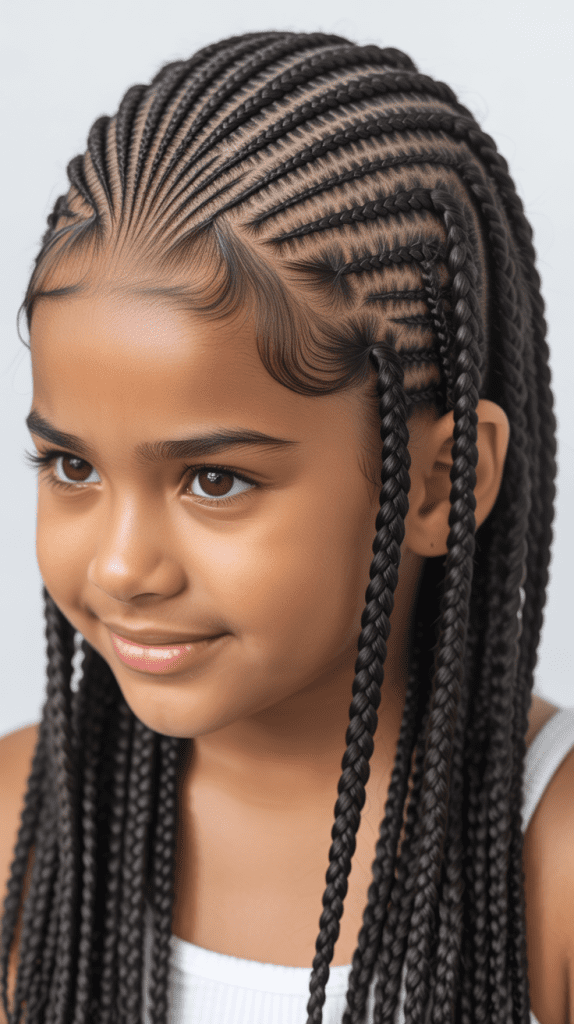
Cornrows into box braids combine two protective styling techniques in a seamless transition from scalp to length.
This hybrid approach features cornrows at the roots that extend a few inches before transitioning into individual box braids for the remainder of the length.
The combination provides the security and neatness of cornrows at the scalp with the movement and versatility of box braids at the ends.
Transition Technique:
- The cornrow section typically extends 2-4 inches from the scalp
- Each cornrow then splits into individual strands that become separate box braids
- The transition point should be smooth and secure to prevent unraveling
- Extension hair is often added during the transition for added length and fullness
- The resulting style offers the benefits of both braiding methods simultaneously
Dual Benefits:
- Cornrows at the roots reduce tension on the hairline compared to all-over box braids
- Box braid ends provide mobility and styling versatility for ponytails and updos
- The combination lasts longer than box braids alone due to the secured roots
- Maintenance is simplified with cornrows keeping the scalp section neat and controlled
- Children enjoy the swing and movement of box braid ends
Styling Possibilities:
- The box braid section can be gathered into high ponytails, buns, or half-up styles
- Individual braids can be wrapped, twisted, or accessorized independently
- The length allows for creative arrangements impossible with only cornrows
- Color can be added to the box braid section while keeping roots natural
- The style accommodates various lengths from shoulder-length to waist-length
31. Wavy Cornrow Pattern
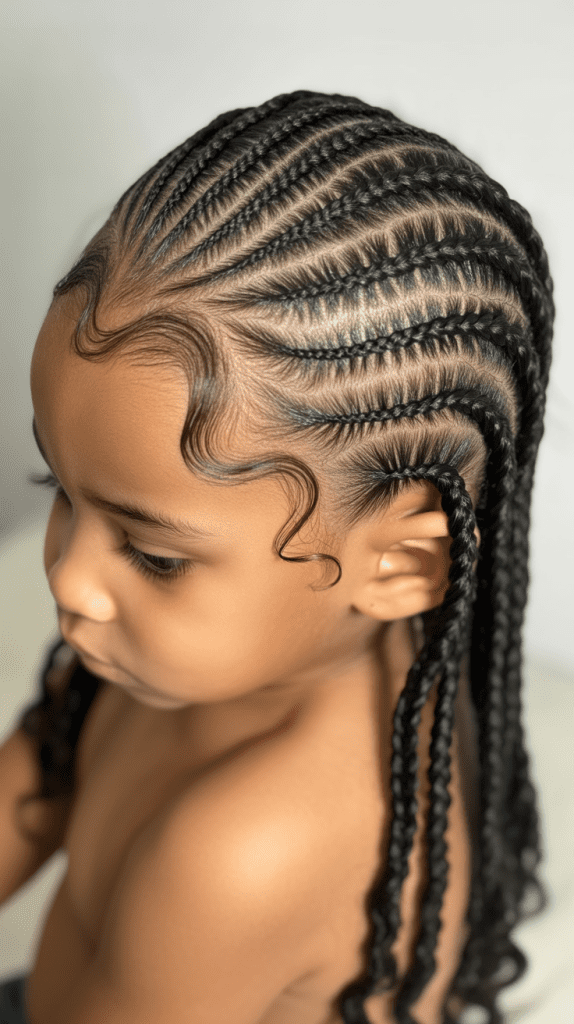
Wavy cornrow patterns feature gently undulating rows that flow across the scalp in smooth, rhythmic curves.
Unlike zigzag patterns with sharp angles, these designs create soft, ocean-wave-like formations that add organic movement and visual interest.
The flowing aesthetic suits children with gentle personalities and parents seeking softer alternatives to geometric designs.
Wave Characteristics:
- The curves are gradual and consistent, resembling natural water ripples
- Multiple parallel wavy rows create mesmerizing repetitive patterns
- The amplitude of waves can vary from subtle undulations to dramatic curves
- Braiders adjust tension and direction throughout to maintain smooth wave shapes
- The flowing lines create optical illusions of movement across static hair
Aesthetic Appeal:
- The organic patterns feel softer and more approachable than angular designs
- Wavy rows complement round face shapes by adding horizontal visual interest
- The rhythmic repetition creates calming, harmonious effects
- This style photographs beautifully with light creating shadows in the wave valleys
- The natural-feeling pattern works for both casual and formal settings
Technique Mastery:
- Creating uniform waves requires consistent hand positioning and tension control
- The braider must plan the wave pattern before beginning to ensure proper spacing
- Gentle curves are easier to execute than tight zigzags, making this accessible for intermediate braiders
- The wavelength and amplitude should remain consistent across all rows for professional results
- Edge control helps define wave patterns clearly at the hairline
32. Cornrow Bob
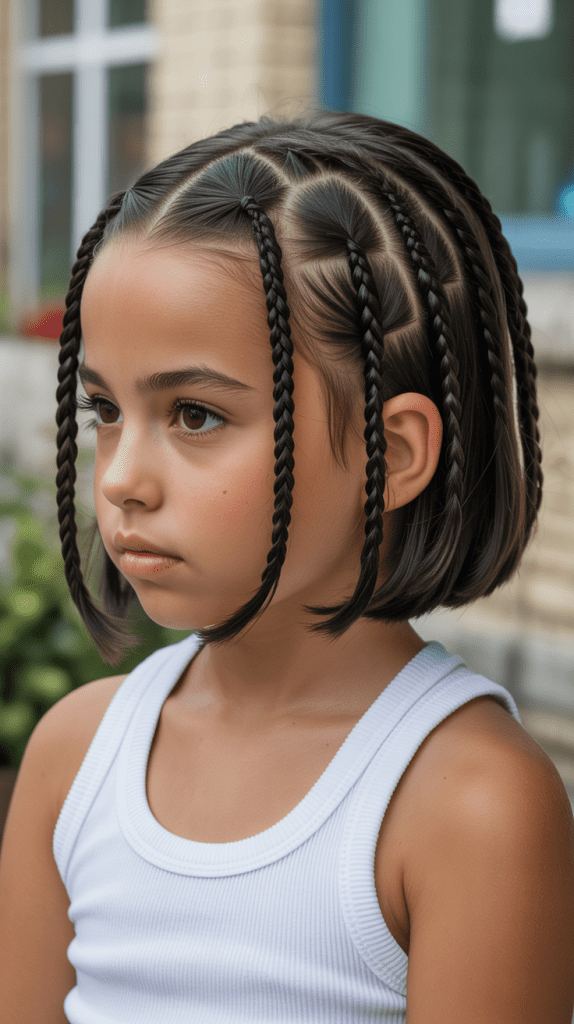
The cornrow bob creates a protective style that mimics the classic bob haircut silhouette through strategic braiding and cutting or styling of extensions.
This contemporary approach features cornrows that extend to chin or shoulder length, often with blunt or angled ends that frame the face similarly to a traditional bob.
The style offers protective benefits while maintaining a polished, mainstream-acceptable aesthetic.
Bob Specifications:
- The length typically falls between the jawline and shoulders for true bob proportions
- Extensions can be cut to precise lengths for sharp, uniform ends
- Some versions feature angled cuts with front pieces longer than back pieces
- The cornrow pattern underneath can be simple straight-back or more complex designs
- The bob length keeps hair manageable while still providing styling versatility
Modern Appeal:
- This style bridges natural hair protective styling and contemporary fashion trends
- The bob length feels fresh and current rather than traditional or dated
- Children can experience a short-hair look without actually cutting their natural hair
- The face-framing length draws attention to facial features attractively
- The style works beautifully in professional, academic, and social settings
33. Festival Cornrows with Accessories
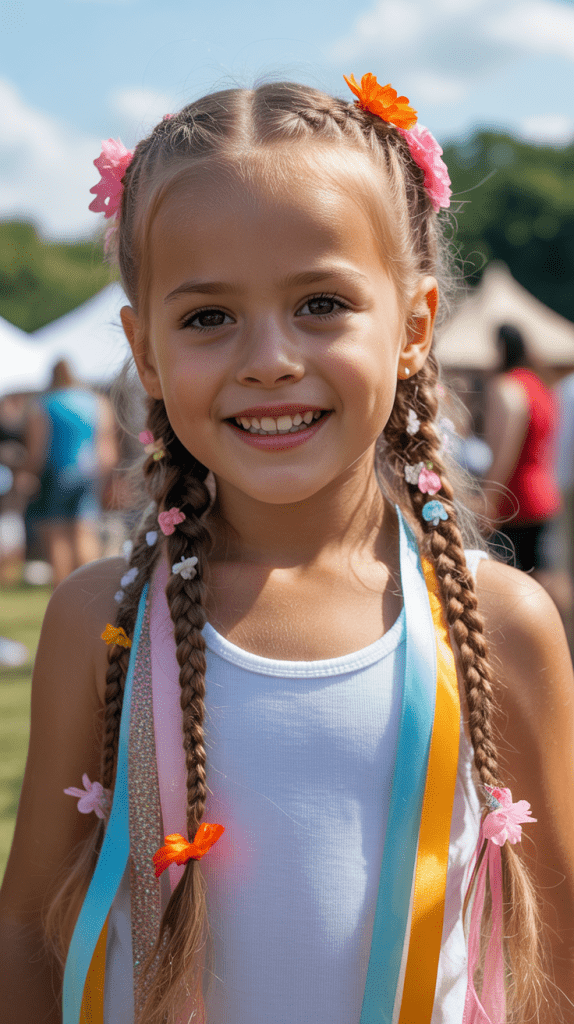
Festival cornrows with accessories embrace creative freedom through bold combinations of braiding patterns, vibrant colors, and eclectic decorative elements.
This maximalist style celebrates individuality and artistic expression, making it perfect for music festivals, cultural celebrations, summer camps, or any occasion where children can fully express their creative personalities without conventional restraints.
Creative Freedom:
- Multiple braiding patterns and techniques can be combined in a single style
- Color is embraced enthusiastically through extensions, temporary sprays, or chalk
- Accessories include flowers, feathers, glitter, ribbons, and unconventional elements
- The style prioritizes fun and self-expression over formal perfection
- No two festival cornrow styles need to look alike—uniqueness is celebrated
Accessory Integration:
- Fresh or artificial flowers can be woven directly into braids for bohemian effects
- Glitter gels and sprays add sparkle along parts and on cornrow surfaces
- Colorful ribbons weave through braids creating streamer-like effects
- Temporary metallic tattoos applied to the scalp show through cornrow parts
- Face paint or gems around the hairline complement the overall festival aesthetic
Occasion Suitability:
- Perfect for outdoor summer festivals, concerts, and cultural celebrations
- Ideal for creative camps, art programs, and expressive play environments
- Suitable for family gatherings where fun and celebration take priority
- Great for vacation periods when school dress codes don’t apply
- Allows children to experiment with bold looks in safe, temporary ways
Maintenance Tips for Children’s Cornrows
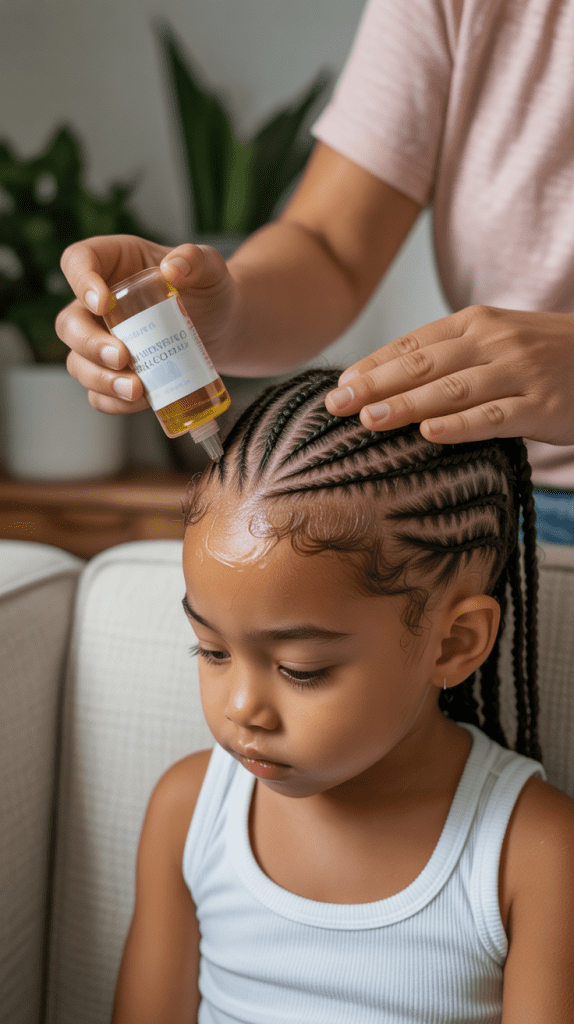
Proper maintenance ensures cornrow styles remain neat, comfortable, and protective throughout their wear period.
Understanding daily care routines helps parents and children maximize style longevity while maintaining hair health.
Daily Care Routine
Moisture Management:
- Apply light oil or moisturizing spray to the scalp every 2-3 days
- Focus on the parts between cornrows where scalp dryness typically occurs
- Use water-based leave-in conditioners to maintain hair moisture without buildup
- Avoid heavy products that can cause residue accumulation between braids
- Coconut oil, jojoba oil, or specialized braid sprays work effectively
Night Protection:
- Always sleep with a satin or silk bonnet to prevent frizzing and lint accumulation
- Alternatively, use a satin pillowcase if the child removes bonnets during sleep
- Ensure the bonnet covers all braids completely for maximum protection
- Replace bonnets regularly as elastic weakens over time
- Consider durags for children who prefer them over bonnets
Weekly Maintenance
Scalp Cleansing:
- Dilute gentle shampoo with water in an applicator bottle for targeted cleansing
- Apply directly to the scalp along parts without saturating entire braids
- Massage gently with fingertips to remove buildup and stimulate circulation
- Rinse thoroughly, allowing water to run along braids without excessive manipulation
- Pat dry with a microfiber towel and allow to air dry completely
Edge Care:
- Reapply edge control to hairline areas that have become fuzzy or loose
- Use a soft-bristled brush or edge brush for smoothing without excessive pulling
- Avoid daily edge manipulation which can cause traction alopecia
- Consider protective gel alternatives specifically formulated for children’s delicate hairlines
- Monitor for signs of thinning or irritation at the hairline
Signs It’s Time to Remove Cornrows
Duration Guidelines:
- Most cornrow styles should be removed after 4-6 weeks maximum
- Longer wear periods risk matting, excessive tangling, and hygiene issues
- New growth becomes noticeable after 3-4 weeks, affecting the style’s appearance
- Children with faster hair growth may need earlier removal
Visual Indicators:
- Significant frizzing along the braid lengths signals the need for removal
- Visible new growth creating space between cornrows and the scalp
- Parts widening or becoming less defined
- Buildup accumulation despite regular cleansing efforts
- The child experiencing increased itching or discomfort
Hair Health Considerations
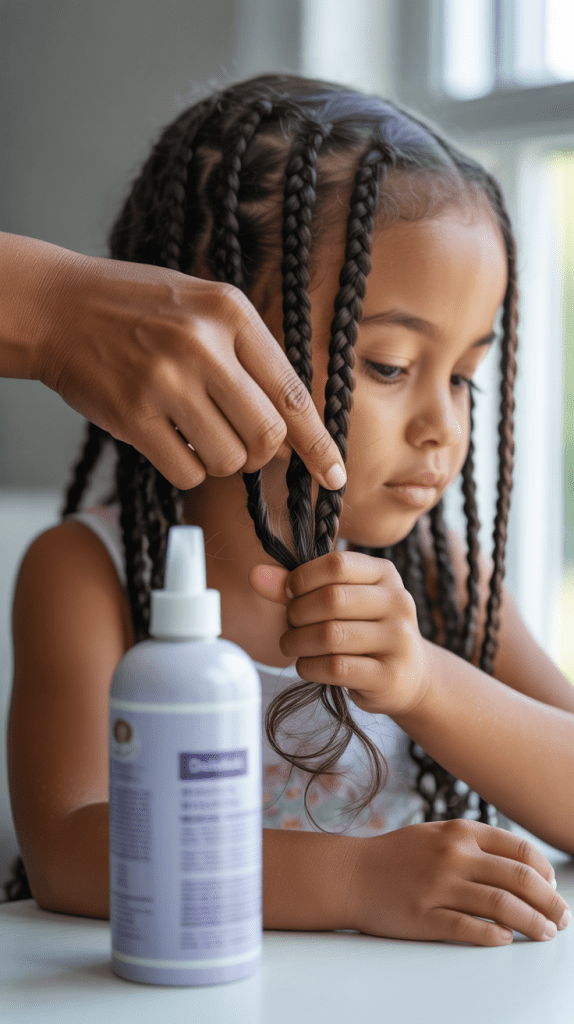
Maintaining the health of children’s natural hair while wearing cornrows requires attention to tension, hydration, and proper removal techniques.
Preventing Traction Alopecia
Tension Awareness:
- Cornrows should feel secure but never painful during or after installation
- The “bump test” – gently push the base of a cornrow; it should have slight give
- Excessive tension causes immediate discomfort and long-term hair loss
- Communicate openly with braiders about comfort levels throughout the process
- Children should never experience headaches or scalp tenderness from braiding
Hairline Protection:
- Avoid starting cornrows too far forward beyond the natural hairline
- Request looser tension specifically at the temples and edges where hair is most fragile
- Give the hairline periodic breaks between protective styles
- Monitor for receding or thinning along the frontal hairline
- Discontinue tight styling immediately if thinning is observed
Hydration and Nutrition
Internal Factors:
- Adequate water intake supports overall hair health and growth
- Protein-rich diets provide building blocks for strong hair structure
- Vitamins A, C, D, and E contribute to scalp health and hair vitality
- Biotin and omega-3 supplements may support hair health when recommended by pediatricians
- Balanced nutrition impacts hair strength more significantly than topical products alone
External Moisture:
- Natural hair requires more moisture than other hair types due to its structure
- Water-based moisturizers penetrate the hair shaft more effectively than oil-based products
- The LOC method (Liquid, Oil, Cream) helps seal moisture into braided hair
- Humectants like glycerin attract moisture from the environment
- Regular deep conditioning before installing cornrows prepares hair for protective styling
Proper Removal Process
Safe Removal Techniques:
- Never rush the removal process which can cause breakage and damage
- Use the pointed end of a rattail comb to gently loosen braid ends
- Work slowly from ends toward roots to minimize tangling
- Apply a detangling spray or conditioner to ease the unbraiding process
- Have patience—removal should take at least half the installation time
Post-Removal Care:
- Expect significant shedding as naturally shed hairs trapped in braids release
- Gently finger-detangle before using any combs or brushes
- Deep condition thoroughly after removal to restore moisture
- Avoid immediately re-braiding—allow hair to rest for at least one week
- Trim any split ends or damage before the next protective style
Choosing the Right Cornrow Style
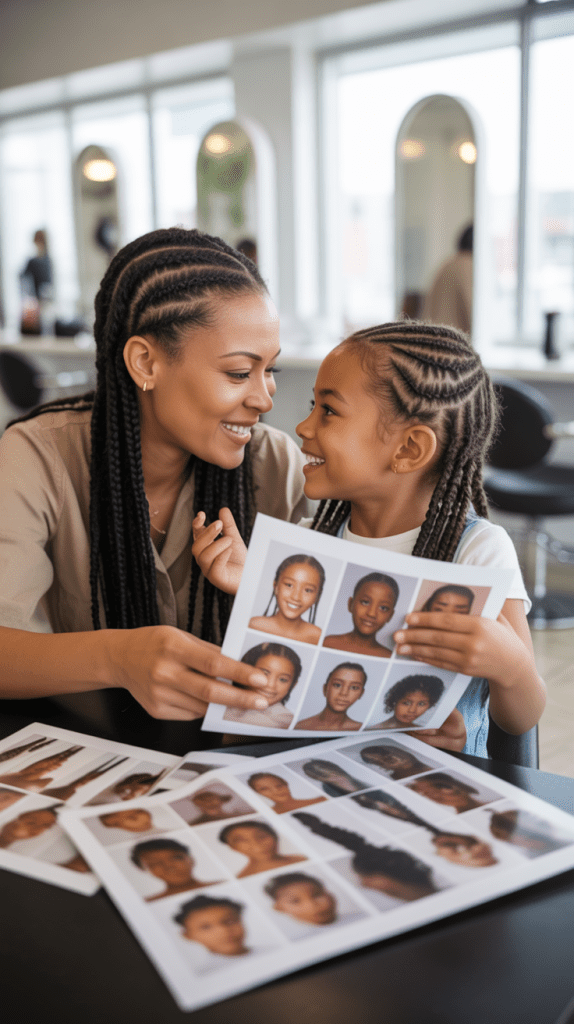
Selecting the appropriate cornrow design involves considering the child’s age, lifestyle, hair characteristics, and personal preferences.
Age-Appropriate Styling
Toddlers (Ages 2-4):
- Simple 3-5 row straight-back designs minimize sitting time
- Avoid heavy extensions which can strain developing neck muscles
- Keep sessions short with breaks for movement and snacks
- Choose comfortable styles that won’t interfere with nap time
- Prioritize the child’s comfort over style complexity
Young Children (Ages 5-9):
- Moderate complexity with 6-12 cornrows works well for this age group
- Children begin developing personal style preferences worth considering
- School dress codes may limit certain creative or colorful options
- Active play requires secure styles that withstand sports and recess
- Build positive associations with hair care through fun, age-appropriate designs
Preteens (Ages 10-13):
- More complex patterns and longer sitting tolerance allow for intricate designs
- Personal expression becomes increasingly important at this developmental stage
- Peer influence and trending styles factor heavily into preferences
- Consider styles that photograph well for social media and group photos
- Balance creative expression with school and activity appropriateness
Lifestyle Considerations
Active/Athletic Children:
- Prioritize secure, close-to-scalp styles that won’t interfere with sports equipment
- Avoid very long extensions that could get caught or pulled during activities
- Choose moisture-resistant styles for children involved in swimming
- Consider styles that don’t require daily manipulation or adjustment
- Protective styles help maintain hair health despite frequent washing from sports
Formal/Academic Settings:
- Understand and comply with school hair policies regarding styles and colors
- Choose neat, professional-appearing cornrow patterns for conservative environments
- Natural hair colors and subtle accessories work best in formal settings
- Ensure styles remain neat-looking throughout the school week
- Balance self-expression with institutional expectations
Conclusion
The journey through these Top 33 Best Cornrow Hairstyles for Kids with Natural Hair reveals the incredible versatility, cultural significance, and protective benefits of cornrow braiding.
From classic straight-back rows perfect for everyday wear to intricate geometric patterns ideal for special occasions, cornrows offer endless possibilities for celebrating and protecting children’s natural hair texture.
These styles honor African heritage while adapting to modern aesthetics, providing options that work for every personality, lifestyle, and skill level.
Whether you choose simple designs that take less than an hour or invest in complex patterns that showcase true artistry, cornrows deliver the dual benefits of hair protection and beautiful presentation.
By following proper maintenance routines, respecting your child’s comfort, and selecting age-appropriate designs, you can ensure that cornrow styles remain a positive, confidence-building part of your child’s hair care journey.
Remember that the best cornrow style is one that makes your child feel comfortable, confident, and proud of their natural hair while keeping it healthy and protected for continued growth and vitality.
