

Cutting curly hair can feel like navigating a minefield of potential disasters, but it doesn’t have to be that way.
Whether you’re a professional stylist or someone brave enough to trim your own curls at home, understanding the unique structure and behavior of curly hair is essential for achieving beautiful, healthy results.
The “10 Pro Tips to Cut Curly Hair Without Damage” will transform your approach to curly hair cutting, helping you avoid common pitfalls that lead to frizz, uneven lengths, and damaged strands.
This comprehensive guide covers everything from preparation techniques and proper tools to advanced cutting methods that work with your hair’s natural curl pattern.
You’ll discover professional secrets for maintaining curl integrity, creating balanced shapes, and ensuring your curls bounce back beautifully after every cut.
By the end of this article, you’ll have the confidence and knowledge to achieve salon-quality results while preserving the health and vitality of curly hair.
1. Start with Clean, Detangled Hair

Proper preparation is the foundation of any successful curly hair cut.
Clean hair allows you to see the true curl pattern and texture without the interference of product buildup or oils.
Detangling before cutting prevents unnecessary breakage and ensures smooth, even cuts throughout the process.
- Wash hair with a sulfate-free shampoo to avoid stripping natural oils
- Apply a generous amount of conditioner and detangle gently with a wide-tooth comb
- Work from the ends upward to minimize breakage during the detangling process
- Rinse thoroughly to remove all product residue that could interfere with cutting
- Squeeze out excess water with a microfiber towel rather than rubbing vigorously
2. Cut Hair When Damp, Not Soaking Wet
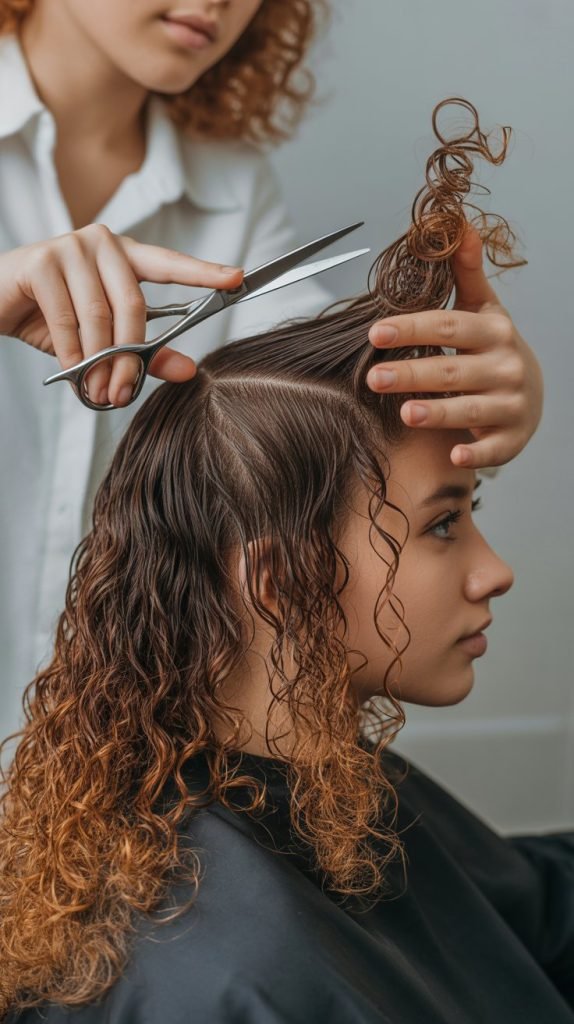
The moisture level of curly hair during cutting significantly impacts the final result. Damp hair provides the perfect balance between manageability and natural curl formation.
Too wet, and you’ll lose sight of the curl pattern; too dry, and the hair becomes difficult to work with and prone to breakage.
- Remove excess water by gently squeezing hair with a microfiber towel
- Hair should feel moist to the touch but not dripping wet
- Allow natural curl pattern to begin forming before making any cuts
- Maintain consistent dampness throughout the cutting process by misting if needed
- Avoid using regular terry cloth towels that can cause frizz and disruption
3. Use Sharp, Professional-Grade Scissors

The quality of your cutting tools directly affects the health and appearance of curly hair after cutting.
Sharp scissors create clean cuts that prevent split ends and fraying.
Dull blades crush and tear the hair shaft, leading to damage that becomes more apparent as curls dry and contract.
- Invest in high-quality hairdressing scissors with sharp, fine blades
- Keep scissors properly maintained and professionally sharpened
- Use scissors specifically designed for hair cutting, not household scissors
- Clean scissors between cuts to prevent hair buildup that can dull blades
- Consider different scissor types for various cutting techniques and curl textures
4. Cut Curls Individually, Not in Sections

Curly hair has a mind of its own, with each curl potentially having a different length and pattern.
Cutting curls individually allows you to work with their natural formation and create a more balanced, organic shape.
This technique prevents the choppy, uneven results that often occur when treating curly hair like straight hair.
- Isolate each curl or small curl group before cutting
- Follow the natural curl pattern rather than forcing hair into artificial sections
- Allow curls to spring back into their natural position before moving to the next
- Work around the head systematically to maintain balance and symmetry
- Take frequent steps back to assess the overall shape and balance
5. Use the Twist-and-Cut Method

The twist-and-cut technique is particularly effective for curly hair because it works with the hair’s natural spiral pattern.
This method helps create layers that enhance curl formation while maintaining length consistency.
It’s especially useful for removing bulk without sacrificing the overall shape.
- Twist small sections of hair in the direction of natural curl pattern
- Cut at various points along the twisted section for layered effect
- Use this method to reduce bulk in thick, dense curly hair
- Vary the angle and depth of cuts to create natural-looking layers
- Practice the technique on less visible sections first to build confidence
6. Never Cut Curly Hair Straight Across

Straight-across cuts look unnatural and unflattering on curly hair because curls don’t grow or lay in straight lines.
This cutting approach often results in a triangular or pyramid shape that lacks movement and bounce.
Instead, create gentle curves and angles that complement the hair’s natural movement patterns.
- Follow the natural curve of the hairline and curl pattern
- Create subtle angles that enhance the hair’s natural movement
- Use point cutting or slide cutting techniques for softer edges
- Build layers gradually rather than making dramatic length changes
- Consider the hair’s natural growth patterns when determining cut lines
7. Master the Dry Cutting Technique

Dry cutting allows you to see exactly how the curls will look in their natural state.
This technique is invaluable for fine-tuning the shape, removing unwanted bulk, and creating precise detail work.
Many professional curl specialists prefer dry cutting for its accuracy and predictable results.
- Allow hair to dry completely in its natural curl pattern before cutting
- Use this technique for final shaping and detail work
- Remove individual curls that stick out or disrupt the overall silhouette
- Perfect for creating face-framing layers and removing bulk
- Combine with wet cutting techniques for comprehensive curl shaping
8. Avoid Over-Thinning and Excessive Layering

While layers can enhance curly hair, too many layers or excessive thinning can remove the hair’s natural weight and support structure.
This often leads to frizz, loss of curl definition, and difficulty styling. Conservative layering approaches typically yield better results for most curl types.
- Use thinning shears sparingly and only when absolutely necessary
- Focus on strategic layer placement rather than overall hair reduction
- Maintain enough weight to support curl formation and prevent frizz
- Consider the client’s curl pattern and density before adding layers
- Test small sections before committing to extensive thinning
9. Work with Natural Curl Patterns, Not Against Them

Every person’s curl pattern is unique, ranging from loose waves to tight coils.
Successful curly hair cutting requires understanding and respecting these natural patterns rather than trying to force hair into unnatural shapes.
Working with curl patterns creates more flattering, manageable, and long-lasting results.
- Identify the client’s specific curl pattern before beginning
- Adapt cutting techniques to work with natural curl formation
- Consider how different curl patterns respond to various cutting methods
- Account for curl shrinkage when determining final length
- Educate clients about their specific curl pattern and maintenance needs
10. Finish with Proper Styling Techniques

The way curly hair is styled immediately after cutting significantly impacts the final result and client satisfaction.
Proper finishing techniques enhance curl definition, reduce frizz, and showcase the precision of your cutting work.
These techniques also help clients understand how to maintain their new cut at home.
- Apply leave-in conditioner or curl cream to damp hair using prayer hands method
- Scrunch hair gently upward to encourage curl formation
- Use a diffuser on low heat and speed settings to dry hair
- Avoid touching or manipulating curls while they dry
- Finish with a light oil or serum to add shine and reduce frizz
Mastering the art of cutting curly hair without damage requires patience, practice, and respect for the hair’s natural characteristics.
These “10 Pro Tips to Cut Curly Hair Without Damage” provide a comprehensive framework for achieving beautiful, healthy results that enhance rather than fight against natural curl patterns.
Remember that every curl is unique, and what works for one client may need adjustment for another.
The key to success lies in understanding curl behavior, using proper techniques and tools, and always prioritizing hair health over dramatic transformations.
By implementing these professional strategies, you’ll build confidence in your curly cutting abilities while delivering results that keep clients coming back.
Whether you’re cutting your own curls or working on clients, these techniques will help you achieve the bouncy, well-shaped curls that everyone desires while maintaining the integrity and health of the hair.
